Youth Goalie Gloves vs Adult Goalkeeper Gloves: Which Is Best for Your Child? (2026)
By Carlos Alvares
As an Amazon Associate I earn from qualifying purchases. This post contains affiliate links which means I may receive a small commission at no extra cost to you if you make a purchase through a link. I only recommend gear I have personally tested and thoroughly evaluated.
The Mistake That Costs Goalkeeper Parents Money Every Single Season
Here is a situation that plays out thousands of times every season.
A parent searches for goalkeeper gloves for their child. They find an adult pair in size 5 or 6 — recognizable brand good reviews noticeably cheaper than the youth specific equivalent. The size looks right. They buy it.
Three weeks later the gloves are uncomfortable , the finger protection feels wrong and the latex is already showing wear. A replacement pair is ordered. This time they spend more. The cycle repeats.
The problem was never the budget. It was the assumption that adult goalkeeper gloves in small sizes are the same product as youth goalie gloves — just smaller.
They are not. And understanding exactly why changes every future purchasing decision you make for your young goalkeeper.
The Short Answer
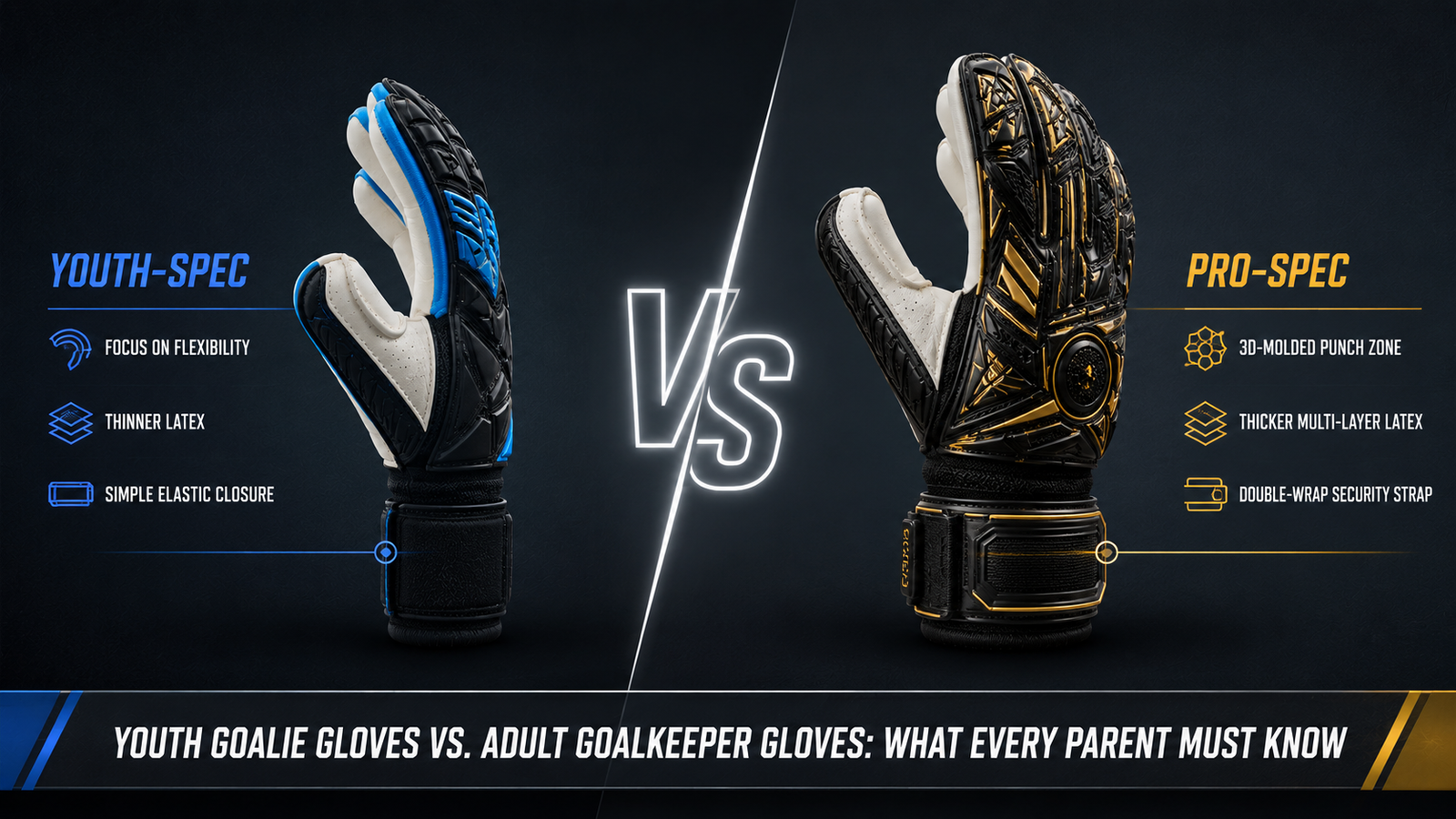
Adult goalkeeper gloves and youth goalie gloves are engineered differently from the ground up — not variations of the same product at different sizes. The palm geometry ,the finger protection positioning the latex formulation the wrist closure and the construction stiffness all reflect the specific demands of their intended audience.
Buying adult gloves in small sizes for a young goalkeeper produces a glove that fits the overall hand dimension but fails on every other engineering dimension simultaneously. That combination of failures explains the frustration that most parents attribute to poor quality — when the actual cause is a product mismatch.
Six Differences That Explain Everything
1. Palm Geometry — Children’s Hands Are Not Small Adult Hand
This is the foundation of everything else and the difference most parents never consider.
A child’s hand is not a proportionally identical scaled down version of an adult hand. The ratio between palm width finger length and finger spacing changes significantly through childhood and adolescence. Children have proportionally shorter fingers relative to palm width than adults — a difference that persists through early teenage years and only resolves as hand development completes.
Genuine youth goalie gloves account for these proportional differences directly. The finger channels are shorter and more closely spaced. The palm panel is wider relative to finger length. Every dimension reflects the actual proportions of a young hand rather than the proportions of an adult hand at a smaller overall size.
Adult gloves in small sizes use adult proportions at smaller overall dimensions. The glove fits the hand in overall measurement — but the internal geometry works against the actual shape of a young hand in every specific dimension. The practical result is a glove that feels slightly wrong in ways the child cannot articulate and the parent cannot easily identify — because the overall size appears correct.
2. Finger Protection Positioning — This One Has Real Injury Consequences
Finger protection spines exist for one specific purpose — resisting backward hyperextension at the knuckle joints during impact . For a spine to perform this function it must sit precisely at the knuckle joint — spanning the joint to resist backward force exactly where hyperextension occurs.
In a correctly designed youth goalie gloves pair the spines are positioned for the knuckle locations of a young hand with proportionally shorter fingers. In an adult glove worn by a child the spines sit at positions calibrated for adult finger length — which means they bridge the wrong point on shorter child fingers.
A spine that does not sit at the knuckle joint does not protect that joint. The protection appears to be present — the spine is there visually — but its mechanical resistance is not applied at the point where hyperextension actually happens on a child’s hand.
For a parent whose primary concern is injury prevention this single difference makes adult gloves in small sizes the wrong choice regardless of any other consideration. The protection that justified the purchase is not functioning as intended.
3. Latex Formulation — Youth Training Demands Are Different From Adult Patterns
Adult goalkeeper gloves are engineered around adult training and competitive patterns — typically one or two training sessions weekly and weekend matches. The latex formulations reflect those demands.
Young goalkeepers in organized youth programs train differently — often two to three times weekly on artificial turf at ages where the position is new and motivating. Genuine youth goalie gloves from specialist brands calibrate their latex specifically for this training frequency and surface combination.
Adult match-day latex used by a young goalkeeper training three times weekly on artificial turf deteriorates significantly faster than youth specific latex at equivalent use levels — because the adult formulation was never designed for that training pattern. The apparent price saving on the initial purchase disappears within the first replacement cycle.
4. Wrist Closure — Security Affects Technique Development
The wrist closure keeps the glove on the hand through dynamic saves dives and ground recoveries. A closure that does not hold securely allows the glove to shift during saves — reducing catching precision regardless of latex quality.
Adult wrist closures are sized for adult wrist circumferences. At small adult sizes the closure still accommodates an adult wrist measurement that is meaningfully larger than a young goalkeeper’s wrist at the equivalent glove size.
A young goalkeeper wearing an adult closure that does not hold correctly develops compensating habits — catching in ways that minimize glove movement rather than in ways that maximize catching effectiveness. Those habits become embedded in technique and cost significantly more to correct than the price difference between youth and adult gloves saved.
5. Construction Stiffness — The Wrong Resistance for Developing Hands
Adult goalkeeper gloves are built to absorb the shot power of adult competitive soccer. The foam backing and construction stiffness that provide appropriate protection against adult shots create unnecessary rigidity for the impact forces young goalkeepers actually face.
This stiffness affects how the glove responds during catches. A young goalkeeper wearing adult construction foam backing feels more resistance when closing the hand — the foam is calibrated for harder impacts than they are facing and that stiffness works against the natural hand closure that developing catching technique requires.
Youth specific construction allows more natural hand movement during catches — supporting the development of correct technique rather than creating resistance calibrated for a different level of play.
6. The Amazon Verification Problem — Small Sizes Do Not Mean Youth Specific
This is the most practical difference for parents making purchasing decisions — and the source of more wrong purchases than any other single factor.
Many adult goalkeeper glove listings on Amazon include size 4 size 5 and size 6 availability. These sizes exist because adult goalkeepers with smaller hands purchase them. The gloves are adult products — but small size availability makes them appear in youth goalkeeper glove searches and makes them look appropriate for young players.
The Age Range Description field in the Amazon product details table is the only reliable verification. If it says Adult — the glove is an adult product regardless of what sizes are available. If it says Youth Kids Junior or Child — the listing is confirmed appropriate for young players.
Thirty seconds of checking this field before every purchase eliminates the most common and most expensive mistake when it comes to buying youth soccer goalie gloves .
The One Honest Exception Worth Understanding
One specialist brand takes a different approach that sits honestly between the two categories — Renegade GK.
Renegade GK does not engineer separate anatomically distinct youth glove lines. They scale their professional grade master patterns across a unified sizing matrix from size 5 through to size 11. The confirmed youth sizes — 5 through 8 — deliver the exact same professional grade latex and construction as adult sizes rather than a compromised budget youth version.
The trade off is equally honest. Renegade GK youth sizes use adult hand proportions scaled down rather than youth specific palm geometry. The advantage is genuine — young players get professional grade features without the quality compromise that most brands make in their youth lines. The limitation is the absence of the youth specific palm calibration that brands like Reusch engineer specifically for younger hand proportions.
For parents choosing Renegade GK the recommendation is confirmed youth sizes 5 through 8 only. Sizes 9 and above are adult sizes regardless of which model. The unified philosophy delivers something valuable — it just delivers it differently from a traditionally youth specific construction approach.
What This Means When You Buy
The summary is straightforward.
Never purchase a goalkeeper glove for a young player based on size availability alone. Check the Age Range Description field in the Amazon product details before every purchase. If it says Adult — move on regardless of what sizes are listed.
If it says Youth Kids Junior or Child — you have a confirmed youth specific product and the engineering differences covered in this guide are working in your child’s favor rather than against them.
The difference between a correctly chosen youth goalie gloves pair and an adult glove in a small size is not visible on the product listing. It shows up in how the glove fits how effectively the finger protection works how reliably the wrist closure holds and how long the latex lasts under youth training demands.
Every one of those differences matters more than the price gap that made the adult alternative look attractive in the first place.
Ready to find the right confirmed youth specific pair? Our Best Youth Goalie Gloves 2026 guide covers nine verified picks across every age group and budget — every product confirmed youth specific before being included. Not sure which size to order? Our Youth Goalie Gloves Size Chart covers the exact measurement method for every brand.
The Bottom Line
Youth goalie gloves and adult goalkeeper gloves are fundamentally different products. Palm geometry finger protection positioning latex formulation wrist closure and construction stiffness all differ in ways that directly affect fit protection performance and lifespan for a young goalkeeper.
Small size availability on adult listings is not the same as youth specific design. The Age Range field is the only reliable verification. Thirty seconds checking it before every purchase is the simplest and most effective thing a goalkeeper parent can do to avoid the mistake that costs more in replacements across a season than any price saving on the initial purchase justified.
Buy youth specific. Verify before purchasing. And give your young goalkeeper equipment built for their hands — not scaled down from someone else’s.
FAQ:
Can a child use adult goalkeeper gloves in a small size?
Technically yes — but with meaningful consequences for fit protection and performance. Adult gloves in small sizes use adult hand proportions that differ from child hand proportions in ways that affect finger protection positioning wrist closure security and palm geometry. A child wearing adult gloves in a small size is wearing a glove not designed for their hand shape regardless of whether the overall dimension fits.
How do I know if a goalkeeper glove is genuinely youth specific?
Check the Age Range Description field in the Amazon product details table. If it says Youth Kids Junior or Child the listing is confirmed appropriate for young players. If it says Adult the glove is an adult product regardless of what sizes are available. Size availability alone never confirms youth specific construction.
Are youth goalie gloves more expensive than adult goalkeeper gloves?
At equivalent quality tiers they are comparable in price. The apparent saving from buying adult gloves in small sizes disappears when incorrect fit produces more frequent replacement or when poorly positioned finger protection fails to prevent an injury that correctly positioned spines would have stopped.
What is the youngest age for youth goalie gloves?
Confirmed youth goalkeeper gloves are available from size 3 — appropriate for players from approximately age 5 to 6. Before age 5 dedicated goalkeeper gloves are generally unnecessary — hand size and developmental stage make the position itself the focus rather than specialist equipment.
Does Renegade GK make genuine youth specific gloves?
Renegade GK scales professional grade adult patterns across a unified sizing matrix — sizes 5 through 8 are confirmed as kids and youth sizes delivering the same professional grade latex as adult sizes. This delivers professional grade features in youth sizes without the youth specific palm geometry that brands like Reusch engineer specifically for younger hand proportions. Both approaches serve young goalkeepers well — differently.
Why do adult goalkeeper gloves come in size 4 or 5?
Adult goalkeepers with smaller hands purchase these sizes regularly. Size 4 and 5 adult listings exist for adult purchasing patterns — not youth specific design. A size 5 adult glove and a size 5 youth specific glove share the same overall dimension but use completely different internal geometry calibrated for different hand proportions.