Youth Goalie Jersey: Long Sleeve vs Short Sleeve — Which One Does Your Child Actually Need? (2026)
By Carlos Alvares |
As an Amazon Associate I earn from qualifying purchases. This post contains affiliate links which means I may receive a small commission at no extra cost to you if you make a purchase through a link. I only recommend gear I have personally researched and evaluated.
Youth Goalie Jersey Sleeves: The Decision Most Parents Overthink
When parents contact me about choosing a youth goalie jersey , the sleeve length question comes up more consistently than almost anything else.
Long sleeve or short sleeve. Which one is better. Which one is safer. Which one their child will actually wear without complaining through a full season.
The honest answer is that for most youth goalkeepers in most situations this decision makes itself — once you understand what each sleeve length actually does and what it does not do for a young goalkeeper.
This guide gives you that understanding in plain language. By the end you will know exactly which sleeve length serves your child’s specific situation — and which verified jersey to buy once you have made the decision.
The Short Answer
Long sleeve is the correct default for most youth goalkeepers in most situations.
Not because short sleeve is bad. Not because long sleeve always wins. But because the specific demands of the goalkeeper position — ground contact , elbow protection and temperature regulation across variable weather — are better served by long sleeve construction in the majority of youth soccer contexts.
Short sleeve has its place. That place is more specific than most parents assume. Understanding exactly when short sleeve makes sense is what this guide covers.
What Sleeve Length Actually Affects
Sleeve length in a youth goalie jersey is not a cosmetic choice. It directly affects three things that matter for a young goalkeeper’s performance protection and comfort.
Elbow Protection — The Most Important Factor
This is where sleeve length makes its most significant practical difference — and where the decision becomes immediately clear for most parents.
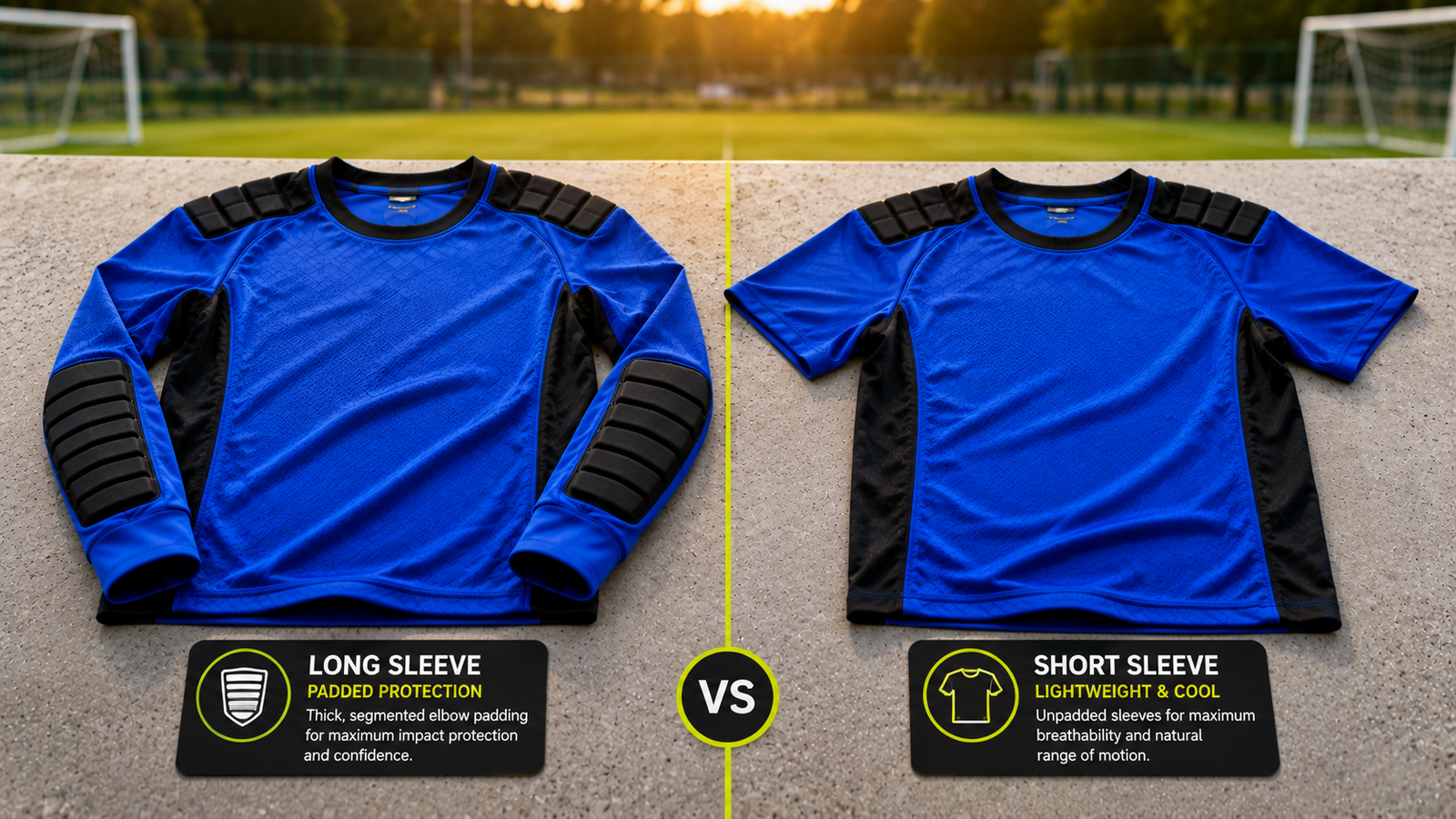
Every genuine padded youth goalie jersey integrates elbow padding into the sleeve. That padding sits correctly at the elbow joint when the sleeve length places it precisely at the right position during a dive. When the sleeve length is wrong the padding slides — either above the joint toward the upper arm or below it toward the forearm — and provides essentially no protection at the moment of ground contact.
Long sleeve goalkeeper jerseys position elbow padding correctly at the joint for the full range of arm positions a diving save produces. The sleeve stays in place during the extension of a dive and during the ground contact that follows. The padding is where it needs to be every single time.
Short sleeve goalkeeper jerseys have no sleeve to position padding in. The elbow is entirely uncovered. Every dive produces direct contact between the elbow and the playing surface — grass or artificial turf — with nothing between them.
For any child training or playing on artificial turf the practical consequence of this difference is immediate and visible. A young goalkeeper in a short sleeve jersey on a 3G pitch comes home with scraped raw elbows after the first session. The hesitation that follows — the unconscious reluctance to commit to the next diving save — is more damaging to their development than any technical limitation.
The honest rule: If your child’s jersey needs to provide elbow protection — and on artificial turf it does — long sleeve is not optional.
Temperature Regulation — The Most Misunderstood Factor
Most parents assume short sleeve automatically means cooler. The reality is more nuanced — and understanding it prevents the most common warm weather jersey mistake.
A youth goalie jersey is not an outfield shirt. A goalkeeper is never static between saves — constantly repositioning communicating sprinting off the line and distributing quickly. The sustained physical demand generates significant body heat regardless of sleeve length.
The fabric construction of the jersey — the moisture-wicking technology and breathability of the polyester — determines how effectively that heat is managed. The sleeve length determines far less of the thermal comfort equation than most parents assume.
A long sleeve jersey made from high-quality moisture-wicking performance polyester — Nike Dri-FIT Adidas Climacool or Adidas AEROREADY — manages heat as effectively in warm conditions as most short sleeve alternatives. The sleeve adds minimal thermal load when the fabric is doing its job correctly.
A short sleeve jersey made from low-quality basic polyester manages heat poorly regardless of sleeve length — because the fabric is the thermal management system not the sleeve.
The honest rule : Choose the jersey based on fabric quality first and sleeve length second for temperature management decisions.
Freedom of Movement — The Least Significant Factor
Parents sometimes worry that long sleeves restrict the arm movement diving saves require. This concern is understandable and almost entirely unfounded for correctly fitted goalkeeper jerseys.
A youth goalie jersey designed for the position — as opposed to an outfield shirt adapted for goalkeeper use — is cut specifically to allow full arm extension in long sleeve construction. The stretchable performance fabrics used across every quality goalkeeper jersey on the market extend fully with arm movement and return without restriction.
The only situation where long sleeves restrict movement is a jersey that is too small — and that is a sizing problem not a sleeve length problem. A correctly sized long sleeve goalkeeper jersey allows full extension saves without restriction.
The honest rule: If long sleeves feel restrictive the jersey is too small. Size up. Do not switch to short sleeve.
When Long Sleeve Wins — The Majority of Situations
Long sleeve is the right choice for most youth goalkeepers in most situations. Here is the specific breakdown:
Any child who trains or plays on artificial turf:
Long sleeve is non-negotiable for artificial turf. The abrasion from rubber crumb infill on synthetic surfaces produces elbow injuries that unprotected sleeves cannot prevent. A young goalkeeper who comes home with scraped elbows after their first artificial turf session hesitates to dive in the next one — and that hesitation holds back their development more than any technical limitation. Long sleeve with elbow padding prevents that hesitation before it becomes a habit.
Any child playing year-round competitive soccer:
Year-round competitive soccer means variable weather — warm September evenings and cold wet February mornings on the same pitch. Autumn and winter matches demand the arm coverage and thermal management that long sleeve provides. A child who switches between long and short sleeve across the season also introduces unnecessary sizing and fit variables. One long sleeve pair for the full competitive season is simpler more protective and more practical than managing two different sleeve lengths across changing conditions.
Any child aged 8 to 12 still developing diving confidence:
Young goalkeepers between 8 and 12 are still learning to commit fully to diving saves — and that commitment is directly connected to how confident they feel about hitting the ground. A young goalkeeper who dives without hesitation because they trust their equipment develops faster than one who holds back because they remember what happened to their elbows last time. Long sleeve with elbow padding builds that confidence from the very first session. Short sleeve removes it entirely.
Cold weather and wet conditions
Long sleeve provides meaningful additional warmth and coverage during autumn and winter play — the seasons when competitive youth soccer produces its most demanding match conditions. Short sleeve in cold wet conditions produces the kind of physical discomfort that pulls a young goalkeeper’s concentration away from the match and toward their own body temperature. Long sleeve is the only practical choice for year-round competitive youth soccer in variable weather climates.
Summer-only recreational leagues in consistently hot climates:
If your child plays exclusively in summer months in a warm climate and trains on natural grass only — short sleeve is a practical and comfortable choice. The protection limitation is less relevant on natural grass in controlled recreational conditions. The thermal comfort advantage is real in sustained heat and a young goalkeeper who is genuinely more comfortable in short sleeve will perform better than one who is distracted by warmth in a long sleeve jersey they resent wearing.
As a second jersey in the two-jersey system:
A short sleeve performance jersey as the warm weather training option alongside a long sleeve match day jersey is a sensible approach for competitive players in consistently warm climates. The short sleeve handles summer training comfort. The long sleeve handles competitive match protection and cold weather play. Both needs are served without compromise and neither jersey is asked to do something it was not designed for.
When worn over a padded compression undershirt:
A short sleeve goalkeeper jersey worn over a Storelli BodyShield or equivalent padded compression undershirt delivers the clean lightweight feel of short sleeve with the elbow protection of a fully padded long sleeve alternative. This is the approach used by serious competitive youth goalkeepers in warm weather competitive play who need their club jersey appearance on the outside with maximum XRD protection underneath. Both requirements are met simultaneously without any visible compromise on either.
The Age and Surface Decision Table
| Situation | Best Choice | Why |
|---|---|---|
| Artificial turf — any age | Long sleeve | Elbow padding essential on synthetic surfaces |
| Natural grass — under 10 | Long sleeve | Building diving confidence needs protection |
| Natural grass — 10 to 14 | Long sleeve — short sleeve in warm weather | Technique established — heat becomes a factor |
| Year-round competitive | Long sleeve | Variable weather demands consistent coverage |
| Summer only recreational | Either works | Grass surface — heat management priority |
| Cold weather matches | Long sleeve | Warmth and coverage non-negotiable |
| Over padded undershirt | Either works | Protection handled underneath |
The Honest Answer to Every Common Parent Question
My child says long sleeves are too hot. What should I do?
Check the fabric first. A long sleeve jersey in high-quality moisture-wicking performance polyester — Nike Dri-FIT or Adidas Climacool — manages heat significantly better than a long sleeve jersey in basic polyester. The complaint about heat is almost always a fabric quality problem not a sleeve length problem. Upgrade the fabric before switching to short sleeve.
My child plays in summer tournaments. Is short sleeve better?
For grass-only summer tournaments in warm climates short sleeve is a reasonable choice. Add separate elbow guards if the tournament includes any artificial turf matches. For year-round players who also use these jerseys in autumn and winter competitive play long sleeve remains the more practical investment.
My child’s club requires a specific jersey. Can they wear short sleeve underneath?
Yes — this is exactly the situation where the short sleeve jersey over a padded compression undershirt approach works best. The club jersey goes on top maintaining the required team appearance. The padded undershirt provides elbow protection underneath. Both requirements are met simultaneously.
Does long sleeve restrict movement during wide extension saves?
Only if the jersey is too small. A correctly sized long sleeve youth goalie jersey from any specialist brand allows full arm extension without restriction. If your child complains about restriction in long sleeves — measure their sleeve length and compare to the brand size chart. The jersey needs to be larger not shorter.
Which Verified Jerseys to Buy Based on Your Decision
If long sleeve is your choice:
The KELME Kids Padded Goalkeeper Shirt delivers the strongest combination of long sleeve elbow protection and accessible pricing on the verified Amazon list — the honest recommendation for most parents choosing long sleeve protection for their child.
For competitive club players who want specialist goalkeeper brand quality in long sleeve the Reusch Match II Youth Padded Goalkeeper Jersey brings nine decades of goalkeeper-specific engineering to the long sleeve padded option.
For match day use specifically the Just 4 Kicks Campeon Youth Goalkeeper Jersey provides the broadest long sleeve padding coverage — both elbows and forearms — in the most visually distinctive design on the verified list.
If short sleeve is your choice
No dedicated short sleeve youth goalkeeper jersey appears on the verified Amazon list with the same quality validation as the long sleeve alternatives. The honest recommendation for warm weather use is the Under Armour Boys Wall Goalkeeper Jersey — which while long sleeve uses HeatGear Microthread fabric that manages heat as effectively as most short sleeve alternatives — or the PUMA Team Pacer Youth Goalkeeper Jersey which provides the lightest most breathable construction on the list.
If a genuine short sleeve option is required the honest approach is to purchase a short sleeve version of your preferred brand’s goalkeeper jersey and pair it with separate elbow guards for any session involving artificial turf contact.
Ready to find the right jersey for your child? Our complete Best Youth Goalie Jersey guide covers six verified Amazon picks across every budget and playing surface.
Already sorted on the jersey? Our Best Youth Goalie Gloves guide covers the most important piece of goalkeeper equipment alongside it.
The Bottom Line
For most youth goalkeepers in most situations the sleeve length decision makes itself.
Long sleeve for any child on artificial turf. Long sleeve for year-round competitive play. Long sleeve for cold and wet conditions. Long sleeve for any child still building diving confidence who benefits from knowing their elbows are protected.
Short sleeve for summer-only recreational leagues on grass in consistently warm climates. Short sleeve as the warm weather component of a two-jersey system. Short sleeve when worn over a padded compression undershirt that handles the elbow protection separately.
The youth goalie jersey that fits correctly in long sleeve construction — correct sleeve length positioning the elbow padding at the joint not on the forearm — protects a young goalkeeper’s elbows protects their confidence and protects the diving habit that separates a goalkeeper who dominates their penalty area from one who manages it cautiously.
Get the sleeve length right. Get the sizing right. And give your young goalkeeper the equipment that lets them dive without thinking about the consequences.
FAQ:
Is long sleeve or short sleeve better for a youth goalkeeper?
Long sleeve is better for most youth goalkeepers in most situations. The elbow padding that protects against ground contact during diving saves requires sleeve length to position it correctly at the joint. Short sleeve leaves the elbow completely unprotected. For artificial turf use specifically long sleeve is not optional — the abrasion from rubber crumb infill on synthetic surfaces makes elbow protection essential.
Can a youth goalkeeper wear short sleeve in cold weather?
No — short sleeve in cold wet match conditions produces thermal discomfort that directly affects concentration and performance. Long sleeve provides meaningful additional warmth and coverage during autumn and winter play. For year-round competitive youth soccer in variable weather climates long sleeve is the only practical choice.
Why does my child find long sleeves restrictive during saves?
A long sleeve goalkeeper jersey that feels restrictive during arm extension is almost always too small — not too long. Measure your child’s sleeve length from the base of the neck over the shoulder to the wrist bone and compare to the brand size chart. Size up. The restriction disappears with the correct size. Do not switch to short sleeve to solve a sizing problem.
Do short sleeve goalkeeper jerseys come with elbow padding?
No — elbow padding requires sleeve length to position it correctly at the joint. Short sleeve goalkeeper jerseys provide no elbow protection of any kind. For any child who needs elbow protection — which includes any child training on artificial turf — short sleeve requires separate elbow guards to compensate for the absence of integrated padding.
Is long sleeve too hot for summer soccer?
Not if the fabric is high quality. A long sleeve jersey in Nike Dri-FIT Adidas Climacool or AEROREADY performance polyester manages heat as effectively in warm conditions as most short sleeve alternatives. The sleeve adds minimal thermal load when the moisture-wicking fabric is doing its job correctly. The complaint about heat in long sleeve jerseys is almost always a fabric quality problem not a sleeve length problem.
What is the best approach for warm weather competitive play?
Two options work well for warm weather competitive play. The short sleeve goalkeeper jersey worn over a padded compression undershirt — providing clean lightweight feel with elbow protection underneath. Or a high-quality long sleeve moisture-wicking jersey in performance polyester that manages summer heat effectively while maintaining elbow protection. Both serve warm weather competitive demands without compromising protection.
Related Guides
- Best Youth Goalie Jersey 2026 — The Complete Parent Guide
- Best Padded Youth Goalie Jersey — 4 Verified Amazon Picks
- Youth Goalie Jersey Size Guide: How to Measure Your Child Correctly
- Best Youth Goalie Gloves 2026 — The Ultimate Parent Buying Guide
Have a specific question about sleeve length for your child’s specific situation? Drop it in the comments — every question gets a real answer.