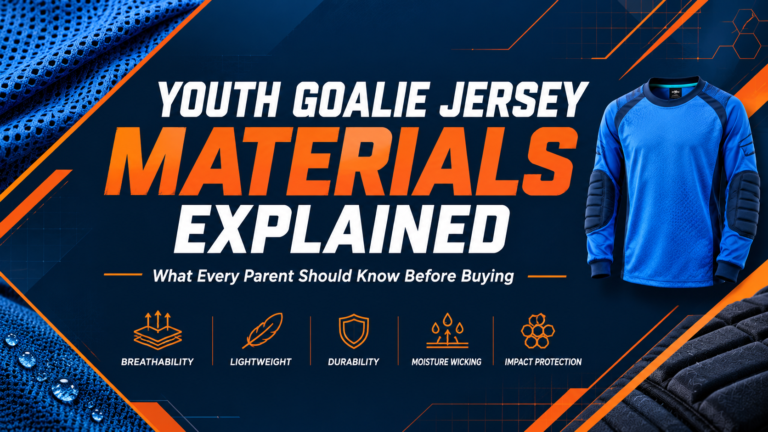
Youth Goalie Jersey: Don’t Buy Until You Check These Features

By Carlos Alvares
As an Amazon Associate I earn from qualifying purchases. This post contains affiliate links which means I may receive a small commission at no extra cost to you if you make a purchase through a link. I only recommend gear I have personally researched and evaluated.
Youth Goalie Jersey Shopping: Why the Product Listing Tells You Almost Nothing Useful
Every youth goalie jersey on Amazon claims the same things.
Maximum grip. Superior protection. Advanced moisture management. Professional goalkeeper design. Breathable performance fabric.
Every single one. From the nine dollar no-name jersey to the eighty-five dollar Storelli. Every listing uses the same language to describe products that perform very differently from each other in real goalkeeper training and match conditions.
The problem is not that brands lie about their products. The problem is that without a framework for reading goalkeeper jersey specifications — understanding what the terms actually mean and which features genuinely matter for a young goalkeeper — every listing looks equally impressive and equally uninformative.
This guide gives you that framework. By the end you will know exactly which features to check on any youth goalie jersey listing before buying which ones to ignore and what the specifications actually mean for how the jersey performs when your child dives on artificial turf in a cold October match.
The Five Features That Actually Matter
Feature 1 — Elbow Padding Type
This is the single most important feature on any youth goalkeeper jersey — and the one where the difference between good and poor options is most immediately apparent.
Every goalkeeper jersey at any price claims elbow padding. Not all elbow padding is equal. Understanding the three padding types tells you everything about how well the jersey protects a young goalkeeper during ground contact.
Sponge foam — entry level. The most basic padding construction found in the lowest-priced youth goalie jerseys. Sponge foam compresses easily and provides minimal impact absorption — adequate for occasional recreational play on natural grass but insufficient for regular training frequency or artificial turf use. Recognizable by how easily it compresses between fingers when handling the jersey. Found in jerseys under fifteen dollars from lesser-known brands.
EVA foam — mid-range standard. The industry standard for quality mid-range youth goalie jerseys. EVA foam is denser than basic sponge — it absorbs meaningful impact force and maintains its protective properties through regular training frequency and washing cycles. It is the correct padding type for the vast majority of youth goalkeepers training twice or three times weekly on natural grass. Found in jerseys from Vizari KELME and INTENZ at fifteen to thirty-five dollars.
Poron XRD — premium standard. The most advanced padding technology available in any youth goalie jersey. Poron is a rate-sensitive material that behaves like flexible foam during normal movement and firms up dramatically on impact — absorbing up to ninety percent of impact force in the moment of ground contact before returning to its flexible resting state. The difference between Poron and EVA foam is most apparent on artificial turf where the rubber crumb infill produces repeated abrasive impact that degrades EVA foam significantly faster than Poron. Found in the Storelli ExoShield range at sixty to ninety dollars.
What to check on any listing: Look for the specific foam type named — not just the claim that padding is present. If no foam type is specified and the listing only says padded or protected — it is almost certainly basic sponge foam regardless of how premium the product photography looks.
Feature 2 — Padding Placement and Positioning
Having the right type of padding means nothing if it sits in the wrong position during a diving save. This is the feature most parents never check and the one that most commonly produces disappointing real-world results from jerseys with adequate padding type.
Goalkeeper diving saves produce ground contact at the elbow joint — the point where the upper arm and forearm meet. The elbow padding in a youth goalie jersey needs to sit precisely at that joint to absorb the impact that matters. Padding that sits above the joint on the upper arm or below it on the forearm provides essentially no protection at the actual point of ground contact.
Stitched-in padding versus inserted padding. The construction method that determines whether padding stays correctly positioned is the most important construction detail to identify before purchasing. Stitched-in padding is sewn directly into the sleeve fabric — it cannot move from its factory position regardless of how many times the jersey is washed or worn. Inserted padding sits in a sleeve pocket and can shift position over time as the sleeve fabric stretches and the foam compresses through use. Most budget youth goalie jerseys use inserted padding that sits correctly on first use and gradually shifts toward the forearm across a season of regular training and washing.
The wrist check. This is the test that confirms whether padding is correctly positioned on any youth goalie jersey after purchase. Have your child put the jersey on and extend one arm straight out to the side. The cuff of the sleeve should reach the wrist bone. If it does the elbow padding sits at the elbow joint during saves. If the cuff reaches only the mid-forearm the entire sleeve is too short and the padding sits above the joint during saves — providing no protection at the point of actual ground contact.
What to check on any listing: Look for language describing the padding as stitched into the sleeve or integrated into the sleeve construction — signals that the padding position is fixed. Avoid jerseys that describe padding as removable or inserted unless the specific construction prevents shifting during use.
Feature 3 — Fabric Technology
The fabric technology claims on youth goalie jersey listings are the area where marketing language most consistently overstates the meaningful performance difference between options. Understanding what fabric technology actually does — and what it does not do — prevents the most common premium overspend driven by impressive-sounding specifications.
What moisture-wicking actually means. Every quality youth goalie jersey at any price above fifteen dollars uses some form of moisture-wicking polyester. This fabric pulls sweat away from the skin to the outer surface of the jersey where it evaporates rather than soaking into the fabric and weighing the jersey down. The fundamental moisture-wicking function is present in every quality goalkeeper jersey at every price tier above basic — it is a baseline requirement not a premium feature.
Named fabric technologies and what they signal. The difference between basic moisture-wicking polyester and branded fabric systems is real but modest for most youth training loads.
K-AIR Cool Technology — found on KELME jerseys — is KELME’s proprietary moisture management system. Lightweight quick-drying and adequately breathable for recreational and developing goalkeeper training demands.
Climacool — found on Adidas jerseys — disperses moisture across the full jersey surface rather than managing it only at specific panels. Produces more even thermal regulation across ninety minutes of competitive play.
AEROREADY — found on Adidas competition jerseys — is Adidas’s most advanced moisture management system in the competition range. Constructed from recycled polyester. Meaningful performance advantage over basic moisture-wicking for sustained high-intensity competitive demands.
Dri-FIT — found on Nike jerseys — is Nike’s moisture-wicking system. The circular knit construction combined with elastane gives genuine multi-directional stretch alongside moisture management.
HeatGear Microthread — found on Under Armour jerseys — is UA’s smoothest most performance-oriented fabric construction. The fastest drying and most effective moisture transport on this list.
The honest truth about fabric technology for youth goalkeepers. The difference between K-AIR Cool and HeatGear Microthread is real and measurable under professional training intensity demands. For a child training twice weekly in recreational youth soccer the practical difference is negligible. Do not pay a premium primarily for fabric technology — pay for the padding type and construction quality that serve your child’s actual training situation.
What to check on any listing: Confirm the jersey is 100% polyester with moisture-wicking construction — the baseline that separates purpose-built goalkeeper jerseys from repurposed outfield shirts. Everything beyond that baseline is a genuine but modest performance increment.
Feature 4 — Cut and Fit
The cut of a youth goalie jersey determines how the jersey moves with a young goalkeeper’s body during the specific actions the goalkeeper position demands — and understanding the three main cut styles helps parents make the right choice for their child’s body type and playing situation.
Slim or athletic cut. The most common cut across quality youth goalie jerseys at every price tier. The slim cut sits closer to the body through the torso — preventing the jersey from bunching under the arm during wide extension saves and preventing excess fabric from being grabbed during corner kick situations. The shoulder seam sits on the shoulder rather than hanging toward the neck. The arms have adequate room for full extension without pulling across the back.
The slim cut is the correct default for most youth goalkeepers. It looks like a real goalkeeper jersey it moves like a real goalkeeper jersey and it stays in place during the dynamic movements that developing technique demands.
Regular or loose cut. Found primarily on budget alternatives and jerseys not specifically designed for the goalkeeper position. A regular cut provides more room through the torso and arms — which sounds advantageous but in practice allows the jersey to bunch under the arm during saves and creates the restriction that the loose fabric produces when it catches during wide lateral reaches.
The exception is the youngest players aged 5 to 8 whose developing technique and comfort preferences make the loose fit of a regular cut more appropriate than the slim athletic alternative.
Compression fit. Found on premium alternatives like the Storelli ExoShield. The compression fit sits tightly against the body — producing the second-skin feel that keeps padding precisely positioned during the most dynamic competitive saves. Appropriate for serious competitive players with established technique. Not appropriate for beginners or younger developing players whose natural hand and arm positions during saves benefit from the freedom of movement a less constrictive fit provides.
The raglan sleeve — a specific design detail worth knowing. Some youth goalkeeper jerseys use raglan sleeve construction — placing the sleeve seam off the shoulder rather than across it. This eliminates the seam that runs across the shoulder in standard construction and removes the restriction that standard shoulder seams produce during overhead punches and wide extension saves. The PUMA Team Pacer uses raglan construction. Worth looking for if shoulder restriction has been an issue with previous jerseys.
What to check on any listing: Look for slim athletic cut or athletic fit language — signals appropriate goalkeeper-specific construction. Avoid any jersey described as relaxed fit or regular fit for a child aged 9 and above who needs the jersey to stay in place during competitive training and match use.
Feature 5 — Color and League Compliance
This is the most practical pre-purchase check and the one most parents do last — occasionally discovering after delivery that the jersey they bought is not permitted in their child’s specific league.
The FIFA goalkeeper color rule requires the goalkeeper’s jersey to be clearly distinguishable from both teams’ outfield jerseys and the referee’s shirt. Most youth soccer associations in the United States follow this guideline. The practical implication is that a goalkeeper jersey in the same color as either team’s outfield kit — even if it is a different shade — may cause a color conflict that prevents your child from wearing it in competitive play.
Colors that pass inspection in virtually every youth league: Neon green. Neon yellow. Orange. Bright electric blue. These colors are sufficiently distinct from virtually every outfield kit color palette used in youth soccer to satisfy referee visibility requirements without league-specific research.
Colors that require confirmation before purchasing: Red. White. Dark blue. Dark green. Black. These colors are more likely to conflict with outfield kit colors used by competitive youth teams — particularly red and white which are among the most common outfield kit colors in youth soccer at every level.
The honest practical advice: Before purchasing any youth goalie jersey in a non-neon colorway check with your child’s coach about both their own team’s kit color and the colors of their most frequent opponents. A neon green or orange jersey avoids this research entirely — both pass inspection in every youth league without exception.
What to check on any listing: Confirm the colorway is available in neon green yellow or orange before ordering any other color if league compliance confirmation is not yet complete.
The Features You Can Safely Ignore
Understanding which marketing claims on youth goalie jersey listings add no genuine value for most youth goalkeepers is as important as understanding which features matter.
“Pro-level design” and professional goalkeeper references. Every youth goalie jersey at every price point claims professional goalkeeper design language of some kind. This claim is marketing not specification. Judge the jersey by its actual padding type construction method fabric quality and fit — not by the professional players referenced in the product description.
Exact GSM fabric weight specifications. Some youth goalie jersey listings cite specific fabric weight in grams per square metre — 150 GSM 200 GSM and so on. For youth goalkeeper use fabric weight within the polyester moisture-wicking range appropriate for goalkeeper jerseys produces no meaningful real-world performance difference. This specification is meaningless for purchasing decisions at youth level.
Anti-bacterial treatment claims. Some youth goalkeeper jerseys claim anti-bacterial fabric treatment that reduces odor. The honest assessment is that the most effective anti-odor measure for any goalkeeper jersey is washing within an hour of every session — which eliminates the bacterial buildup that causes persistent odor regardless of whether the fabric has anti-bacterial treatment. Do not pay extra for anti-bacterial claims.
UPF sun protection ratings. Relevant for players spending extended time in intense direct sunlight during outdoor summer tournaments. Irrelevant as a differentiating feature for the vast majority of youth goalkeeper situations where standard polyester construction provides adequate UV protection for training and match durations.
Reinforced stitching claims. Every quality youth goalie jersey uses reinforced stitching at stress points — this is a baseline construction standard not a premium feature. If a listing highlights reinforced stitching as a selling point it is almost certainly a standard construction feature being presented as a premium one.
The Pre-Purchase Checklist — Five Questions Before Every Youth Goalie Jersey Purchase
Before clicking buy on any youth goalie jersey ask these five questions in order:
What type of foam does the elbow padding use — sponge EVA or Poron? If the listing does not specify — it is sponge foam.
Is the padding stitched into the sleeve or loosely inserted? If the listing does not specify construction method — assume inserted and subject to shifting.
What is the sleeve cut — slim athletic or regular? For players aged 9 and above slim athletic is the correct choice.
Does the sleeve length reach the wrist bone in the listed size? Check the brand size chart against your child’s sleeve measurement from base of neck to wrist bone before ordering.
Is the colorway available in neon green yellow or orange if league color compliance is not yet confirmed?
If every answer is satisfactory — the jersey serves your child’s needs. If any answer is unsatisfactory or unavailable in the listing — find an alternative that answers all five correctly before purchasing.
Ready to find the right jersey now that you know what to look for? Our complete Best Youth Goalie Jersey guide covers six verified Amazon picks across every budget — every product assessed against exactly these five criteria. On a tight budget? Our Best Budget Youth Goalie Jersey Under $30 guide covers seven picks all checked against these same specifications.
Already sorted on the jersey? Our Best Youth Goalie Gloves guide covers the most important piece of goalkeeper equipment alongside it — ten verified picks across every age and budget.
The Bottom Line
A good youth goalie jersey is not the most expensive one on Amazon. It is not the one with the most impressive professional goalkeeper photography in the product listing. And it is not the one with the longest list of technical specifications that sound advanced but mean nothing for how a young goalkeeper actually performs.
A good youth goalie jersey has the right padding type for your child’s training surface. Padding positioned correctly and fixed at the joint rather than sliding toward the forearm. Moisture-wicking polyester construction that keeps the jersey comfortable through the full training session. A slim athletic cut that moves with the goalkeeper’s specific actions without restriction or bunching. And a colorway that satisfies your league’s visibility requirements.
Five features. Five pre-purchase questions. One correct jersey for your child’s specific situation.
Check the five features. Ask the five questions. And give your young goalkeeper a youth goalie jersey that actually does what the listing claims — rather than one that only looks like it does.
FAQ: What Makes a Good Youth Goalie Jersey
What is the most important feature in a youth goalie jersey?
Elbow padding type and positioning — by a meaningful margin over every other feature. A youth goalie jersey with correctly positioned Poron or EVA foam elbow padding that stays at the joint during saves protects a young goalkeeper more effectively than any other single specification. No amount of advanced fabric technology or professional design language compensates for padding that sits in the wrong position or compresses completely on first impact.
How do I know if the padding in a youth goalie jersey will stay in the right position?
Look for language describing the padding as stitched into the sleeve or integrated into the sleeve construction. This means the padding is sewn to the fabric and cannot shift position through use and washing. If the listing describes the padding as removable or inserted without specifying that it is stitched in place — assume it will shift toward the forearm over time. The wrist check after delivery confirms correct positioning regardless of listing language.
What fabric should a youth goalie jersey be made from?
100% polyester with moisture-wicking construction is the baseline that every quality youth goalie jersey at any price above fifteen dollars should meet. Named fabric technologies — K-AIR Cool Climacool AEROREADY Dri-FIT — are genuine performance improvements over basic moisture-wicking polyester but produce modest real-world differences for most youth training loads. Confirm the 100% polyester baseline before evaluating any named technology claim.
What does slim fit mean on a youth goalie jersey and why does it matter?
Slim fit means the jersey is cut closer to the body through the torso — preventing fabric from bunching under the arm during wide extension saves and staying in place during the dynamic movements that goalkeeper technique demands. A regular or loose fit allows excess fabric to catch and restrict during lateral saves — the opposite of what a developing young goalkeeper needs. For players aged 9 and above slim athletic fit is the correct default choice for any youth goalie jersey purchase.
What colors are safe to buy without checking league rules first?
Neon green neon yellow and orange pass inspection in virtually every youth soccer league in the United States without requiring league-specific research. These colors are sufficiently distinct from virtually every outfield kit color palette to satisfy referee visibility requirements without exception. Any other colorway — particularly red white dark blue and black — requires confirmation with your child’s coach before purchasing.
What features on youth goalie jersey listings can I safely ignore?
Pro-level design claims professional goalkeeper references exact GSM fabric weight specifications anti-bacterial treatment claims UPF sun protection ratings and generic reinforced stitching claims. None of these features produce meaningful real-world performance differences for most youth goalkeeper training and match situations. Evaluate jerseys on padding type padding positioning fabric construction cut and colorway — and disregard everything else.
Related Guides
- Best Youth Goalie Jersey 2026 — The Complete Parent Guide
- Best Budget Youth Goalie Jersey Under $30 — 7 Verified Picks
- Best Padded Youth Goalie Jersey — 4 Verified Amazon Picks
- Youth Goalie Jersey Size Guide: How to Measure Your Child Correctly
- Are Expensive Youth Goalie Jerseys Worth It — The Honest Answer
- Best Youth Goalie Gloves 2026 — The Ultimate Parent Guide
Have a specific question about a feature on a jersey listing you are considering? Drop it in the comments — every question gets a real answer.