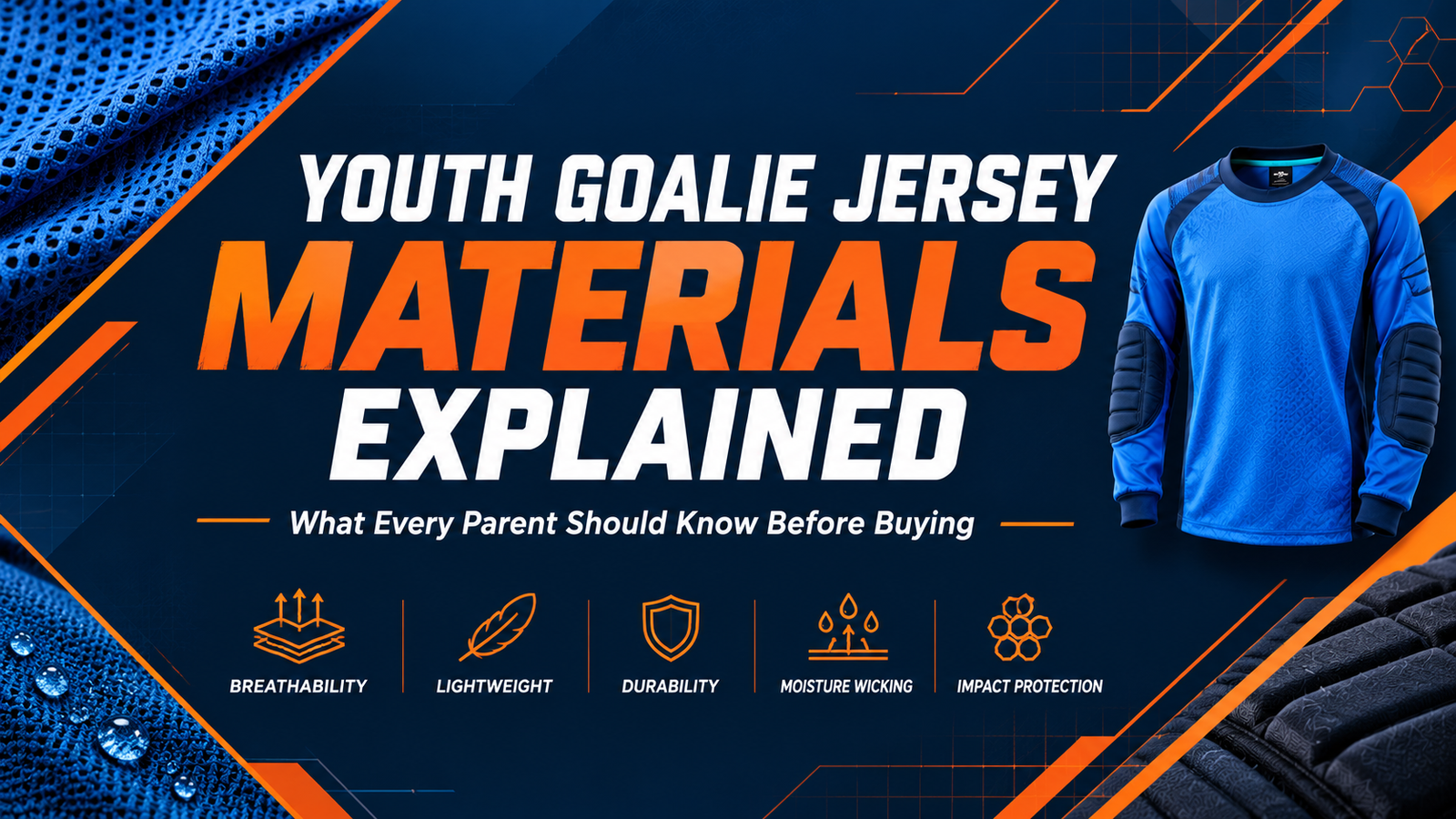
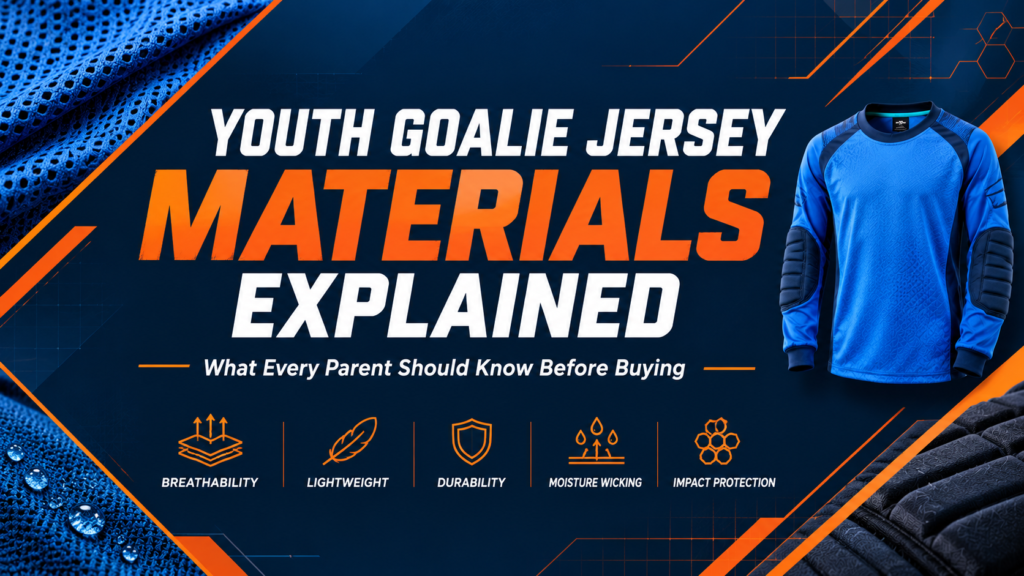
Youth Goalie Jersey Materials Explained: What Every Parent Should Actually Know Before Buying
By Carlos Alvares
As an Amazon Associate I earn from qualifying purchases. This post contains affiliate links which means I may receive a small commission at no extra cost to you if you make a purchase through a link. I only recommend gear I have personally researched and evaluated.
Youth Goalie Jersey Materials: Why the Fabric Matters More Than Most Parents Realize
Most parents buying a youth goalie jersey spend their research time on two things — the price and the color. The material gets a glance at most. It is listed somewhere in the product specifications in a language that means nothing without context — 100% polyester interlock knit moisture-wicking sublimated recycled fabric antimicrobial treatment.
Meaningless unless you know what you are looking for.
Here is why it matters. The material of a youth goalie jersey determines three things that directly affect how your child performs and feels in goal throughout the season. It determines how quickly sweat is pulled away from the skin during high-intensity play. It determines how well the jersey holds its structure and padding position through a full season of weekly washing. And it determines how comfortable the jersey feels against the skin during the extended periods of positioning and communication that fill the time between saves.
Getting the material right produces a jersey that your child barely notices wearing — which is exactly what you want. Getting it wrong produces a jersey that distracts them with discomfort exactly when they need to focus on a ball coming across the box.
This guide explains every material and fabric technology term you will encounter on any youth goalie jersey listing — in plain language with honest assessments of which terms signal genuine performance and which are marketing claims that add no practical value for most youth goalkeepers.
The Foundation Material — Why Every Quality Youth Goalie Jersey Uses Polyester
Every quality youth goalie jersey at every price point above basic is made from polyester — and understanding why explains more about goalkeeper jersey performance than any other single piece of fabric knowledge.
Polyester is a synthetic polymer fibre with two properties that make it specifically suited to goalkeeper jersey construction. It does not absorb water in the way natural fibres like cotton do — water passes through polyester rather than being held in the fibre structure. And it retains its shape under repeated washing and physical stress more consistently than natural fibre alternatives.
These two properties directly serve goalkeeper jersey demands. A goalkeeper who dives slides and dives again across ninety minutes of competitive play generates significant sweat. A cotton jersey absorbs that sweat and holds it — becoming progressively heavier and more restrictive as the match continues. A polyester jersey passes the moisture through to the outer surface where it evaporates — staying close to its dry weight throughout the match regardless of how hard the goalkeeper works.
The consistent shape retention of polyester matters specifically for padded goalkeeper jerseys. The EVA foam and Poron padding sewn into goalkeeper jersey sleeves maintains its position because the polyester fabric holding it does not stretch permanently out of shape through repeated washing. A natural fibre jersey would gradually stretch the sleeve that holds the padding — shifting it away from the elbow joint that it needs to sit over.
Cotton goalkeeper jerseys do exist — typically at the very lowest price points on generic Amazon listings. They are not appropriate for any regular goalkeeper training or competitive use. A cotton youth goalie jersey becomes uncomfortably heavy within twenty minutes of sustained play and never returns to its original weight or shape once it has absorbed a full training session of sweat.
Moisture-Wicking — What the Term Actually Means and When It Matters
Moisture-wicking is the most common fabric technology claim on any youth goalie jersey listing — and also the most frequently misunderstood.
Moisture-wicking does not mean waterproof. It does not mean the jersey will never feel wet. It means the fabric is constructed or treated to move moisture from the inner surface — the surface touching the skin — to the outer surface — where air circulation allows evaporation.
Standard polyester has some natural moisture transport properties due to its non-absorbent fibre structure. A jersey described simply as 100% polyester with no additional moisture-wicking claim will move moisture from skin to outer surface — just more slowly and less completely than a polyester fabric with a dedicated moisture-wicking treatment or construction.
The practical difference between standard polyester and a quality moisture-wicking treated polyester is most apparent during sustained high-intensity activity in warm conditions. A goalkeeper sprinting off the line diving for three consecutive saves and jumping for a high cross generates moisture faster than standard polyester manages it effectively. A quality moisture-wicking treatment keeps pace with that moisture generation — the inner surface stays noticeably drier against the skin even during the most demanding periods of competitive play.
For recreational young goalkeepers training once or twice weekly in moderate temperatures the difference between standard polyester and premium moisture-wicking treatment is small enough that it does not meaningfully affect their experience. For competitive players training three or more times weekly in warm weather the difference is real noticeable and worth paying for.
The Named Fabric Technologies — Decoded Honestly
Every major brand on the verified youth goalie jersey list uses a proprietary name for their moisture-wicking fabric technology. Understanding what each one actually means — rather than what the marketing language suggests — helps parents make the right choice for their specific child.
dryCELL — PUMA
dryCELL is PUMA’s proprietary moisture management system applied to their 100% polyester goalkeeper jersey construction. The technology pulls moisture away from the skin rapidly and transports it to the outer jersey surface where natural air circulation evaporates it.
In practical terms dryCELL delivers faster moisture transport than basic moisture-wicking polyester — particularly during the bursts of high-intensity activity that goalkeeper play produces. The PUMA Team Pacer uses dryCELL construction and is the most breathable jersey on the verified list specifically because the dryCELL system cycles through wet and drying states continuously rather than allowing the fabric to reach full saturation.
dryCELL performs best in conditions with some air movement — on an outdoor pitch where goalkeeper movement creates natural airflow across the jersey surface. In completely still humid indoor conditions the evaporation component of the system is less effective.
Climacool — Adidas
Climacool is Adidas’s moisture management system that disperses sweat across the full jersey surface rather than managing it only at the highest-moisture zones. Where standard moisture-wicking concentrates its transport effect at the most saturated points — typically the chest and underarms — Climacool distributes moisture management across the entire jersey.
The practical result is more even thermal regulation across ninety minutes of competitive play. A jersey with standard moisture-wicking develops wet patches at peak-sweat zones while other areas stay dry. A Climacool jersey maintains more consistent moisture across the full surface — producing a more uniform comfortable feel through the full match duration.
AEROREADY — Adidas
AEROREADY is Adidas’s most advanced moisture management system in the competition range — a step above Climacool in the moisture transport speed and surface coverage. AEROREADY construction is typically found on Adidas competition-grade products including the Tiro 25 and Tiro 26 goalkeeper jerseys.
The specific advancement over Climacool is the recycled polyester construction that AEROREADY uses — material whose fibre structure is specifically optimised for moisture transport rather than standard polyester adapted with a surface treatment. The practical difference over Climacool is modest for most youth training demands but meaningful for sustained competitive use in warm conditions.
Dri-FIT — Nike
Dri-FIT is Nike’s moisture-wicking fabric system — circular knit polyester construction combined with elastane content that gives the fabric genuine multi-directional stretch alongside moisture management.
The circular knit construction is the specific detail that distinguishes Dri-FIT from many budget moisture-wicking alternatives. Circular knit fabrics have no seams running through the body of the material — they are knitted in a continuous tube rather than stitched from flat panels. This seam-free construction eliminates the pressure points that flat-panel seams create against the skin during sustained physical activity — particularly relevant for goalkeeper movement that involves repeated extension of the arms and torso in multiple directions.
The elastane content gives Dri-FIT fabric genuine four-way stretch — the kind that moves with goalkeeper-specific movements and returns without restriction or distortion rather than simply allowing stretch in one direction.
HeatGear Microthread — Under Armour
HeatGear Microthread is Under Armour’s most advanced fabric construction in the competitive range and the highest-performance moisture management system on the verified youth goalie jersey list.
The ultra-smooth polyester knit produces significantly faster moisture transport than standard dryCELL or AEROREADY alternatives — pulling sweat away from the skin so rapidly that the jersey surface stays essentially dry against the skin during even the most demanding periods of competitive hot weather play.
The microthread construction means individual polyester fibres are finer than standard polyester — creating a smoother inner surface that reduces friction against the skin during repeated dynamic movement. For a goalkeeper making diving saves and ground recoveries repeatedly across ninety minutes the reduced friction of microthread construction against the skin is a genuine physical comfort advantage.
HeatGear Microthread is the most advanced fabric on this list and carries the most premium price that reflects that position.
K-AIR Cool Technology — KELME
K-AIR Cool is KELME’s proprietary moisture management system found on their Kids Padded Goalkeeper Shirt. The lightweight quick-drying polyester construction manages moisture adequately for recreational and developing goalkeeper training demands — keeping the jersey lighter and more comfortable than standard non-treated polyester across a full training session.
K-AIR Cool sits below the performance level of dryCELL Climacool and HeatGear Microthread in moisture transport speed — appropriate for the training frequency and intensity demands of most recreational youth goalkeepers rather than for sustained competitive use in extreme warm weather conditions.
Sublimated Construction — What It Means and Why It Matters
Sublimation is a printing process rather than a fabric technology — but it appears on youth goalie jersey listings often enough that understanding it saves parents from a common and disappointing mistake.
In standard jersey printing designs are applied to the surface of the fabric after construction — printed on top of the polyester with inks that sit on the fabric surface. These surface prints crack peel and fade with washing — typically showing visible deterioration within six to eight weeks of twice-weekly machine washing.
In sublimated construction the design is embedded into the fabric itself during manufacturing rather than applied to the surface. The dye becomes part of the fibre structure rather than sitting on top of it. A sublimated design cannot crack peel or flake because there is no surface layer to separate — it is the fabric itself that is the color.
For a youth goalie jersey that will go through the machine twice weekly for six months of a full season the difference between a sublimated design and a surface-printed design is the difference between a jersey that looks as good in March as it did in August and one that looks significantly worse by October.
The Vizari Arroyo and Vizari Vallejo both use sublimated construction. Most KELME goalkeeper jerseys use sublimated designs. When a youth goalie jersey listing does not specify sublimated or dye-sublimated construction — assume surface printing and expect visible design deterioration within the first half of the season.
Foam Padding Materials — EVA vs Poron vs Sponge
The padding material in a youth goalie jersey is as important as the outer fabric — and the three types available across the verified product range deliver meaningfully different performance levels.
Sponge foam is the most basic padding material found in the lowest-priced youth goalie jerseys. It compresses easily provides minimal impact absorption and flattens out progressively through a season of regular use. Adequate for occasional recreational play on natural grass. Not appropriate for regular training frequency on artificial turf where the cumulative impact demands exceed what sponge foam maintains effectively.
EVA foam — ethylene-vinyl acetate — is the industry standard for quality mid-range goalkeeper jersey padding. Denser and more resilient than sponge foam it absorbs meaningful impact force and maintains its protective properties through regular training frequency and washing cycles. EVA foam correctly stitched into the sleeve rather than loosely inserted stays positioned at the elbow joint — the critical factor that determines whether the padding protects the actual impact point or the forearm above or below it.
Poron XRD is a rate-sensitive smart material that behaves like flexible comfortable foam during normal movement and firms up dramatically on impact — absorbing up to ninety percent of impact force in the moment of ground contact before returning to its flexible resting state. The difference between Poron XRD and EVA foam is most apparent on artificial turf where the repeated abrasive impact of rubber crumb infill degrades EVA foam significantly faster than Poron. Found exclusively in premium goalkeeper jerseys — the Storelli ExoShield range — at sixty to eighty-five dollars.
Recycled Polyester — What It Means for Performance
Several youth goalie jerseys on the verified list — most notably the Adidas Tiro 25 and Tiro 26 AEROREADY jerseys — use 100% recycled polyester construction. This is increasingly common across performance athletic apparel as brands respond to environmental commitments.
The honest performance assessment of recycled polyester compared to virgin polyester is straightforward. The moisture management properties of recycled polyester are equivalent to virgin polyester when the recycled material is processed correctly. The mechanical properties — stretch retention shape maintenance and resistance to washing degradation — are similarly equivalent for quality recycled polyester construction.
There is no performance penalty for choosing recycled polyester in a youth goalie jersey. The environmental benefit is real. The performance equivalence to virgin polyester for goalkeeper jersey use is equally real.
The Material Decision Framework — Matching Material to Situation
Understanding the materials is only useful when matched to your child’s specific situation. Here is the honest framework:
For recreational play once or twice weekly on natural grass standard moisture-wicking 100% polyester with sublimated construction delivers everything the situation requires. The K-AIR Cool system in the KELME or the basic polyester in the Vizari Arroyo serves recreational demands without requiring premium fabric investment.
For developing competitive play two to three times weekly on mixed surfaces a quality named moisture-wicking system — dryCELL AEROREADY Climacool — delivers the additional moisture management performance that higher training frequency demands. The PUMA Team Pacer and Adidas Tiro options serve this tier honestly.
For serious competitive play three or more times weekly on artificial turf in warm conditions the combination of premium moisture management — HeatGear Microthread — and quality foam padding — EVA minimum Poron XRD preferred for artificial turf — delivers the full specification that serious competitive goalkeeper demands require. The Under Armour Boys Wall with separate elbow guards or the Storelli ExoShield for the most demanding turf conditions.
Ready to find the right jersey based on what you now know about materials? Our complete Best Youth Goalie Jersey guide covers six verified Amazon picks assessed specifically against these material standards. On a tight budget? Our Best Budget Youth Goalie Jersey Under $30 guide covers seven picks all checked for material quality at accessible prices.
Already sorted on the jersey? Our Best Youth Goalie Gloves guide covers the most important piece of goalkeeper equipment alongside it — ten verified picks with the same honest material assessment approach.
The Bottom Line
The material of a youth goalie jersey is not a secondary specification to check after price and color. It is the specification that determines whether the jersey performs correctly across a full season of regular washing and training use — or whether it deteriorates into an uncomfortable distraction within the first two months.
Polyester is the foundation — always. Moisture-wicking treatment matched to training frequency and temperature demands. Sublimated construction for any jersey that will face a full season of twice-weekly washing. EVA foam correctly stitched in place for any player who needs elbow protection. And Poron XRD specifically for serious competitive players on artificial turf where standard foam reaches its limits.
Match the material to the demands. Not to the marketing language. And give your young goalkeeper a youth goalie jersey whose materials serve their actual situation — rather than one whose specifications look impressive on a listing and disappoint in the first month of real use.
FAQ: Youth Goalie Jersey Materials Explained
What material should a youth goalkeeper jersey be made from?
100% polyester with a moisture-wicking treatment is the baseline that every quality youth goalie jersey should meet. Polyester does not absorb sweat the way cotton does — it passes moisture through to the outer surface where it evaporates. Cotton goalkeeper jerseys become progressively heavier and more restrictive as a session continues and are not appropriate for any regular goalkeeper training or competitive use regardless of price.
What is the difference between dryCELL Climacool AEROREADY and HeatGear Microthread?
All four are proprietary moisture management systems applied to polyester goalkeeper jersey construction. dryCELL from PUMA delivers fast moisture transport for recreational to competitive use. Climacool from Adidas disperses moisture across the full jersey surface for more even thermal regulation. AEROREADY from Adidas is a step above Climacool using recycled polyester optimised for moisture transport. HeatGear Microthread from Under Armour delivers the fastest moisture transport on the verified list through ultra-fine polyester fibres with a smooth inner surface that reduces friction during dynamic movement.
What does sublimated mean on a youth goalkeeper jersey listing?
Sublimation is a printing process where the design is embedded into the fabric during manufacturing rather than printed on the surface after construction. A sublimated design cannot crack peel or fade because it is part of the fabric structure itself. For a youth goalie jersey washed twice weekly across a full season sublimated construction is the only printing method that maintains design integrity through the complete seasonal washing cycle.
What is the difference between EVA foam and Poron XRD padding?
EVA foam is the standard padding material for quality mid-range goalkeeper jerseys — dense resilient and effective for most youth training frequency and surface demands. Poron XRD is a rate-sensitive smart material that firms up dramatically on impact absorbing up to ninety percent of force before returning to its flexible resting state. The difference is most significant on artificial turf where the repeated abrasive impact of rubber crumb infill degrades EVA foam significantly faster than Poron across a competitive season.
Does recycled polyester perform differently from standard polyester in a goalkeeper jersey?
No meaningful performance difference exists between quality recycled polyester and virgin polyester for goalkeeper jersey use. Moisture management properties mechanical stretch retention and washing durability are equivalent when the recycled material is processed correctly. The environmental benefit of recycled polyester is real and the performance equivalence for goalkeeper jersey demands is equally real.
How do I know if a youth goalkeeper jersey uses sublimated or surface-printed design?
Look for the words sublimated dye-sublimated or all-over print in the product description or specifications. If the listing does not specify one of these terms assume surface printing — and expect visible design deterioration through cracking peeling or fading within the first six to eight weeks of twice-weekly machine washing.
Related Guides
- Best Youth Goalie Jersey 2026 — The Complete Parent buying Guide
- Youth Goalie Jersey Features Explained — What Parents Should Check
- Best Budget Youth Goalie Jersey Under $30 — 7 Verified Picks
- Best Padded Youth Goalie Jersey — 4 Verified Amazon Picks
- Are Expensive Youth Goalie Jerseys Worth It — The Honest Answer
- Best Youth Goalie Gloves 2026 — The Ultimate Parent Guide
Have a specific question about a material or fabric technology on a jersey you are considering? Drop it in the comments — every question gets a real answer.