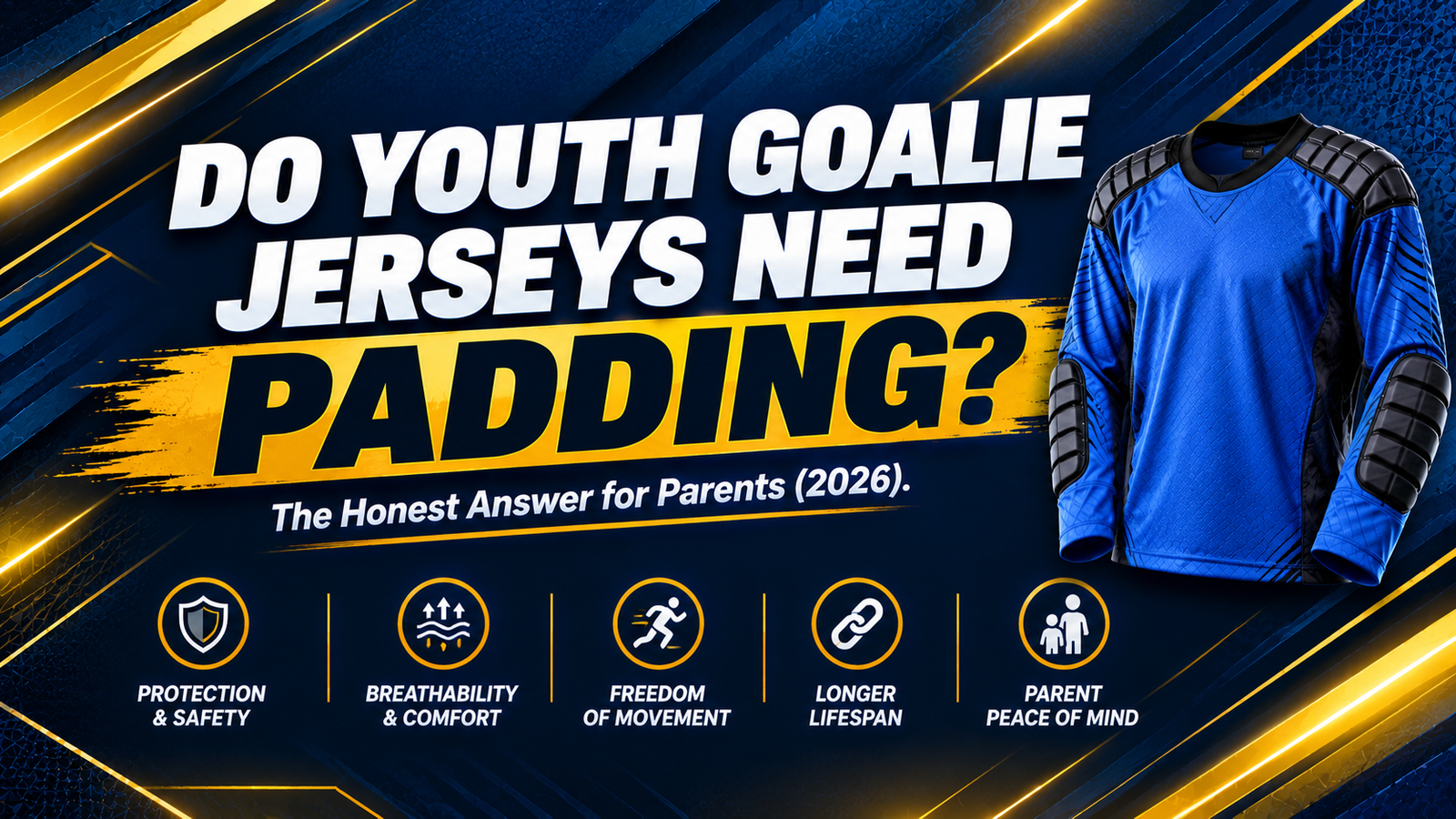
Do Youth Goalkeepers Need a Padded Jersey?Here Is the Honest Answer for Parents
By Carlos Alvares
As an Amazon Associate I earn from qualifying purchases. This post contains affiliate links which means I may receive a small commission at no extra cost to you if you make a purchase through a link. I only recommend gear I have personally researched and evaluated.
The Question Every Goalkeeper Parent Asks Before Buying Their First Jersey
You are looking at two youth goalie jerseys on Amazon.
One has elbow padding — fourteen dollars. One has no padding — twenty-two dollars. A third has padding on the elbows the forearms and the chest — thirty dollars.
The descriptions all claim to be the best choice for young goalkeepers. None of them explain whether your child actually needs padding or what happens if you choose wrong.
So you do what most parents do. You guess. You order the one that looks most impressive or the one that is cheapest or the one with the most reviews. It arrives , Your child wears it , And you spend the rest of the season wondering whether you made the right call.
This guide ends the guessing. By the end you will know exactly whether your child needs a padded youth goalie jersey — based on their specific playing surface , training frequency , and age — and exactly which option serves their actual situation ,rather what the marketing ads tells you to buy .
The Short Answer
Most youth goalkeepers benefit from some level of elbow padding. Whether that padding needs to be integrated into the jersey depends on three factors : the surface they play on, how frequently they train, and how old they are.
For children on artificial turf at any training frequency , yes they need a padded jersey. For children under ten on any surface , yes again they need a padded youth goalie jersey. For recreational players on natural grass training once or twice weekly , the padded jersey is recommended but also a unpadded jersey with separate elbow guards is a good alternative. For warm-weather competitive players on natural grass who have established diving technique , the unpadded jersey with separate elbow guards is a legitimate option.
Everything between those positions is covered below with the honest reasoning behind each recommendation.
What Padding in a Youth Goalie Jersey Actually Does
Before deciding whether your child needs a padded youth goalie jersey it helps to understand exactly what the padding is doing — and what it is not doing — during a diving save.
When a young goalkeeper dives to either side of the goal , the sequence of ground contact follows a consistent pattern regardless of technique level. The hands and gloves contact the ball, The forearms and elbows contact the ground on the save side, and The hip and thigh absorb the final ground contact as the body lands. Of these contact points , the elbow is the most vulnerable — the bony prominence of the elbow joint has minimal natural cushioning and produces sharp localized impact on every diving save.
Elbow padding in a youth goalie jersey absorbs a portion of that impact force through foam compression — reducing the sharpness of the contact and protecting the skin from the abrasion that rough playing surfaces produce. The foam does not eliminate all impact. It reduces it to a level that allows a young goalkeeper to dive without the pain response that unprotected elbow contact produces on harder surfaces.
Here is the critical point that most buying guides omit. The value of that impact reduction is not primarily physical. Young goalkeepers who experience painful elbow contact during diving saves develop an unconscious hesitation — a fractional reluctance to fully commit to the next dive. That hesitation is invisible in the first few sessions. It becomes a visible habit by the end of the season. By the following season it is embedded in the goalkeeper’s movement pattern as a technical problem that coaching time has to address.
A padded youth goalie jersey that prevents that pain response prevents the hesitation before it becomes a habit. That is worth considerably more than the price difference between a padded and an unpadded option.
The Surface Question — The Single Most Important Factor
The playing surface determines more of this decision than any other factor — and it is the factor most parents overlook entirely when choosing a youth goalie jersey.
Artificial Turf — Padded Jersey Is Non-Negotiable
Artificial turf — the rubber crumb infill synthetic surfaces used for the majority of youth soccer training facilities in the United States — produces a specific type of elbow contact during diving saves that natural grass does not.
The rubber crumb infill creates a surface with fine abrasive particles that grind against skin during sliding ground contact. On natural grass a diving goalkeeper’s elbow contacts soft compressible material that absorbs the impact laterally. On artificial turf the same elbow contacts a dense surface of hard rubber particles that produces both impact force and friction simultaneously — the combination that causes the raw scraped elbow skin that parents of artificial turf goalkeepers recognize immediately after the first session.
Standard foam padding in a youth goalie jersey provides meaningful protection against both the impact and the abrasion of artificial turf contact. An unpadded jersey on artificial turf produces the kind of elbow damage — not serious but painful and cumulative — that creates the hesitation habit described above within four to six training sessions.
For any child training or playing on artificial turf at any frequency the padded youth goalie jersey is not a optional upgrade. It is the minimum appropriate protection for the surface demands they are facing.
Ready to find the right padded jersey for your child’s specific surface? Our complete 4 best padded youth goalie jerseys on Amazon covers every verified padded option — padding type placement and construction quality assessed honestly for every playing surface and training situation.
Natural Grass — Padded Jersey Recommended, Unpadded Workable
Natural grass produces significantly lower abrasion and impact forces during diving saves than artificial turf. The compressible nature of grass and the underlying soil means elbow contact on natural grass absorbs impact laterally rather than concentrating it at the contact point the way rubber crumb infill does.
For recreational players on natural grass , a padded youth goalie jersey is recommended but an unpadded jersey with separate elbow guards worn over or under the sleeve is a workable alternative. The key word is workable — not ideal. Integrated padding in the jersey stays correctly positioned through every save without requiring the goalkeeper to check that a separate guard has shifted during play. Separate guards can slide shift and require repositioning during a session in ways that integrated padding does not.
For competitive players on natural grass the integrated padded youth goalie jersey remains the recommendation even though the surface demands are lower than on artificial turf — because competitive play frequency produces more diving saves per session than recreational play and the cumulative contact across a competitive season justifies the protection that integrated padding provides.
Hard Courts and Concrete — Padded Jersey Is Essential
Youth soccer played on hard court surfaces — concrete tarmac or hard-packed dirt — produces the harshest elbow contact conditions of any playing surface. If your child trains or plays on any hard surface , a padded youth goalie jersey is essential and the highest-grade padding available — Poron XRD in the Storelli range — is the honestly appropriate recommendation rather than standard foam alternatives.
The Age Question — Why Young Players Need Padding Regardless of Surface
Age and developmental stage affect the padding decision independently of surface — and for a specific reason that relates to how young goalkeepers learn to dive rather than to the physical demands of the surface itself.
Young goalkeepers aged five to ten are still developing the fundamental technique of diving safely. They have not yet learned to lead with their hands extend fully toward the ball and control the angle and speed of their body’s contact with the ground. In the early stages of learning to dive a child’s elbows contact the ground at higher speed and at less controlled angles than a technically developed goalkeeper’s elbows do during the same type of save.
This means the impact forces at the elbow are higher during early-stage diving development than during technically proficient diving — even on the same surface. A ten-year-old goalkeeper with two years of organized training dives with significantly more control over their ground contact than a six-year-old just learning the position. The six-year-old needs more protection at the elbow during dives precisely because their technique produces less-controlled ground contact.
For this reason , a padded youth goalkeeper jersey is recommended for any child aged five to ten regardless of surface — not because the surface always demands it but because the developmental stage of their diving technique means their elbows need the protection that an experienced goalkeeper’s technique partially provides naturally.
From age ten onward the decision shifts toward surface and frequency as the primary factors — as technique development reaches the level where controlled diving reduces the uncontrolled elbow contact that beginners produce regularly.
Not sure which padded jersey fits where your child is right now? Our best padded youth goalie jersey guide walks through four verified Amazon picks — each one matched honestly to a specific age level surface and protection need so you buy the right one first time
The Frequency Question — When Padding Pays for Itself
Training frequency affects the padding decision through a straightforward cumulative logic. More sessions means more diving saves. More diving saves means more elbow ground contact. More elbow ground contact means more cumulative impact and abrasion across the season.
For a child training once weekly in a recreational setting on natural grass the cumulative elbow contact across a full season is manageable with or without integrated padding. The unpadded jersey with separate elbow guards remains a workable option at this frequency.
For a child training twice or three times weekly the cumulative elbow contact across twenty to thirty sessions is meaningful — and the protection that integrated padding in a youth goalie jersey provides becomes increasingly justified as a season-long investment rather than a session-by-session consideration.
For a child training four or more times weekly at competitive level the cumulative elbow contact is significant enough that integrated padding is not a recommendation — it is the obvious minimum for a child making that volume of diving saves across a competitive season.
The Types of Padding Available — Making the Right Choice
Once the decision to buy a padded youth goalie jersey is made the next question is which type of padding is appropriate for your child’s specific demands.
EVA foam — the standard choice for most youth goalkeepers. Dense resilient and effective for the training frequency and surface demands of most youth goalkeeper situations. EVA foam correctly stitched into the sleeve rather than loosely inserted stays at the elbow joint through repeated sessions and washing cycles. Appropriate for natural grass at all training frequencies and for artificial turf at recreational to moderate training frequency. Found in the Vizari Arroyo KELME Kids Padded and MOTINY Youth Goalkeeper Jersey.
Poron XRD — the choice for serious artificial turf players. The rate-sensitive smart material that firms up on impact absorbing up to ninety percent of force before returning to its flexible resting state. The protection advantage over EVA foam is most significant on artificial turf where the repeated abrasive impact of rubber crumb infill degrades EVA foam’s protective properties across a competitive season more rapidly than Poron XRD. Found in the Storelli ExoShield range at the premium price point that serious competitive artificial turf demands justify.
Basic sponge foam — adequate for occasional recreational use only. The most basic padding construction found in the lowest-priced youth goalie jerseys. Compresses easily provides minimal impact absorption and shifts position over time rather than remaining correctly placed at the elbow joint. Not appropriate for regular training frequency on any surface. Found in entry-level budget options under fifteen dollars.
Ready to move from the decision to the actual jersey? Our complete padded youth goalie jersey guide covers four honest Amazon picks — every product verified in youth sizing with straightforward assessments of what each one delivers and exactly who it serves best.
When an Unpadded Youth Goalie Jersey Is the Right Answer
Integrated elbow padding is not always the right answer — and being honest about when unpadded works is as important as explaining when padding is necessary.
An unpadded youth goalie jersey is appropriate in three specific situations.
For warm-weather summer play on natural grass where heat management is the primary concern, and the goalkeeper has established diving technique. Premium unpadded jerseys deliver significantly better breathability than padded alternatives because they carry no foam weight and allow unrestricted air circulation across the full jersey surface. Paired with separate lightweight elbow guards for any contact situation , they serve warm-weather grass players very effectively.
For technically developed older players aged fourteen and above who have established fully controlled diving technique on natural grass. At this level ,the controlled angle of ground contact during saves — hands leading body angled correctly — reduces the uncontrolled elbow impact that younger developing goalkeepers produce. Separate elbow guards , as needed , replace the permanent integrated padding required in earlier developmental stages .
For club players who must wear a specific team jersey without an integrated padding. The two-piece system — a padded compression undershirt worn beneath the club jersey — delivers equivalent or superior protection to integrated padding while maintaining the required team jersey appearance. This is the approach used by serious competitive youth goalkeepers at club and academy level whose teams require a specific match jersey regardless of its padding configuration.
On a budget? Our Best Budget Youth Goalie Jersey Under $30 guide covers seven picks including the best padded options at the lowest honest prices.
Already sorted on the jersey? Our Best Youth Goalie Gloves guide covers the most important piece of goalkeeper equipment alongside it — ten verified picks across every age budget and playing level.
The Bottom Line
Most youth goalkeepers benefit from a padded youth goalie jersey — but the specific type of padding and whether it needs to be integrated into the jersey or provided by a separate compression undershirt depends on three factors that every parent can assess in under two minutes.
Artificial turf at any age — padded jersey with EVA foam minimum Poron XRD for serious competitive use. Under ten on any surface — padded jersey regardless of surface demands because developing technique produces less-controlled ground contact. Natural grass recreational play — padded jersey recommended but separate elbow guards over an unpadded jersey is workable. Warm-weather grass play for technically developed older players — unpadded premium jersey with separate elbow guards is a legitimate and genuinely practical choice.
Match the padding to the surface the age and the frequency. Not to the most impressive specification on the product listing. And give your young goalkeeper a youth goalie jersey that protects them appropriately for where they actually play — rather than either under-protecting them or overcomplicating a decision that three honest factors make genuinely straightforward.
FAQ: Do Youth Goalkeepers Need a Padded Jersey
Do youth goalkeepers legally need to wear a padded jersey?
No — there is no rule in youth soccer at any level requiring a padded goalkeeper jersey. The decision is entirely practical rather than regulatory. The case for padding is about protecting a young goalkeeper’s elbows during ground contact and preventing the pain-driven hesitation that unprotected elbow contact produces across a season — not about compliance with any governing body requirement.
What age should a child start wearing a padded youth goalkeeper jersey?
From their very first session in goal regardless of age. Young goalkeepers aged five to ten are still developing the diving technique that provides some natural protection through controlled ground contact. Until that technique is established the padded youth goalie jersey protects the elbows that an uncontrolled early-stage dive exposes to harder impact than a technically proficient dive produces.
Is a padded compression undershirt better than a padded youth goalie jersey?
For club players who must wear a specific team jersey — yes. A padded compression undershirt worn beneath the required club jersey delivers equivalent or superior padding while maintaining team appearance. For recreational and developing players who can choose their own jersey — integrated padding in the jersey is simpler requires no additional purchase and cannot be forgotten or left behind.
Can my child wear just elbow guards instead of a padded goalkeeper jersey?
Yes — and for specific situations it is the recommended approach. Warm-weather play on natural grass where heat management is the priority is the clearest case. An unpadded premium jersey for maximum breathability combined with separate lightweight elbow guards addresses both requirements without the heat and weight trade-off that integrated foam padding creates in warm conditions.
How do I know if the padding in a youth goalkeeper jersey is actually positioned correctly?
The wrist check confirms correct sleeve length and therefore padding position. With the jersey on have your child extend one arm straight out to the side. The cuff should hit at the wrist bone. If it reaches correctly the elbow padding sits at the elbow joint during saves. If the cuff stops at the forearm the sleeve is too short and the padding sits above the joint — protecting the wrong point during every dive.
Does more padding always mean better protection?
No — and this is one of the most common misconceptions in youth goalie jersey purchasing. Padding type and positioning matter more than padding volume. A correctly positioned EVA foam pad stitched into the sleeve at the elbow joint provides better protection than a larger sponge foam pad that slides to the forearm during the first session. Poron XRD in a correctly positioned sleeve provides better protection than double-thickness sponge foam that flattens within four sessions on artificial turf. Choose the right padding type correctly positioned over the most padding volume available.
Related Guides
- Best Padded Youth Goalie Jersey — 4 Verified Amazon Picks That Actually Protect Young Goalkeepers
- Best Youth Goalie Jersey 2026 — The Complete Parent Guide
- Best Budget Youth Goalie Jersey Under $30 — 7 Verified Picks
- Youth Goalie Jersey Materials Explained — Complete Parent Guide
- Best Youth Goalie Gloves 2026 — The Complete Parent Guide
Have a specific question about whether your child’s playing situation needs a padded goalkeeper jersey? Drop it in the comments — every question gets a real answer.