Youth Goalie Gloves: Training vs Match Gloves for Better Grip
By Carlos Alvares

As an Amazon Associate I earn from qualifying purchases. This post contains affiliate links which means I may receive a small commission at no extra cost to you if you make a purchase through a link. I only recommend gear I have personally tested and thoroughly evaluated.
The Question Every Goalkeeper Parent Eventually Asks
You are standing at the sideline watching your child train on Tuesday evening when you notice something that has been quietly bothering you for weeks.
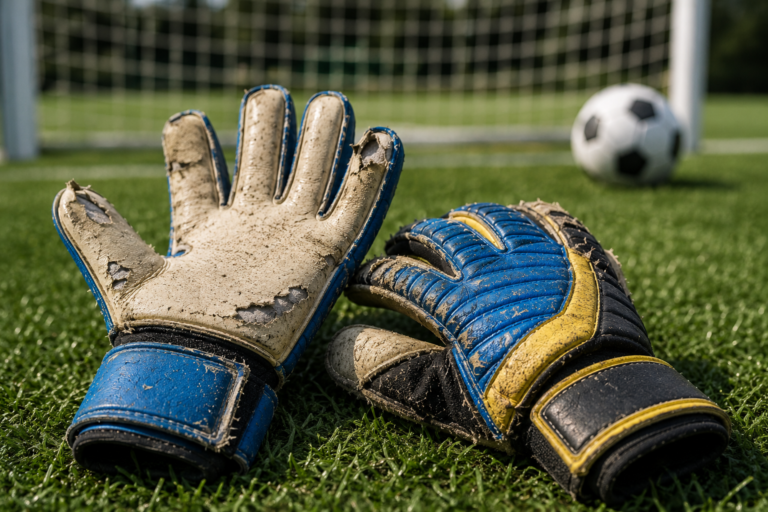
The goalkeeper gloves you bought at the start of the season — the ones that looked impressive on Amazon and felt genuinely quality when they arrived — are already showing wear. The latex palm that gripped so confidently in the first few sessions is now visibly thinner at the fingertips. The grip that made your child catch with such confidence is noticeably less sticky than it was six weeks ago.
The weekend match is on Saturday. Those same gloves need to perform in the most important moment of your child’s goalkeeping week.
This is the moment most goalkeeper parents discover — usually through frustration rather than planning — that youth goalie gloves are not all built for the same purpose. And that using the same pair for everything is one of the most common and most expensive mistakes in youth goalkeeper equipment management.
This guide answers the question honestly and completely. Do youth goalkeepers actually need two pairs of gloves? When does the two-pair system make financial sense? And what specific gloves should go in each role?
The Short Answer
Yes — for any child training twice weekly or more the two-pair system is the more practical and more economical approach.
Not because it is more expensive. Because it is less expensive over a full season than replacing one premium pair every six to eight weeks.
The rest of this guide explains exactly why — and exactly when the two-pair system crosses from optional luxury into genuine practical necessity.
Why Training and Match Day Make Different Demands on Latex
To understand why the same glove cannot optimally serve both purposes you need to understand the fundamental tradeoff in goalkeeper glove latex.
Softer latex grips better but wears faster. Harder latex lasts longer but grips less.
This tradeoff never disappears regardless of price or brand. Every goalkeeper glove ever manufactured sits somewhere on that spectrum — and where it sits determines what it is built for.
Training demands durability above all else.
A young goalkeeper training twice or three times weekly on artificial turf subjects their gloves to:
Six to nine hours of active use every week. Repeated ground contact during dives and ground recovery. Rubber crumb infill abrasion from artificial turf surfaces that destroys soft latex rapidly. Accumulated sweat salt deposits that degrade latex from the inside between sessions. Dynamic stress on seams and closures from the repetition of training frequency.
Under those conditions soft match-day latex deteriorates visibly within weeks. The abrasion resistance that training demands is the opposite of the softness that match-day grip requires.
Match day demands performance above all else.
A young goalkeeper playing one competitive match weekly subjects their gloves to:
A young goalkeeper playing one competitive match weekly subjects their gloves to 60 to 90 minutes of active use — the hardest most accurate shots they face all week arriving under pressure from technically developing opponents. Variable weather conditions they cannot control and cannot reschedule around. And the high-pressure moments where grip confidence matters most — the moments that define how a young goalkeeper feels about their own ability long after the final whistle.
The Economics — Why Two Pairs Costs Less Than One
This is the calculation most parents do not run until they have already replaced their third pair of the season.
The one-pair scenario:
A premium match glove at $50 used for training three times weekly plus weekend matches lasts approximately six to eight weeks on artificial turf before meaningful latex deterioration occurs. Replacing it three to four times across a full season costs between $150 and $200 — for the same glove purchased repeatedly because the one-pair system is working against its own economics.
The two-pair scenario:
A training glove costing $25 to $35 used for all training sessions lasts a full season of 24 to 30 sessions — costing $25 to $35 total. A match glove costing $45 to $55 reserved for matches only lasts a full season with proper care — costing $45 to $55 total. Combined season cost of $70 to $90 compared to $150 to $200 for the one-pair approach — a saving of $60 to $110 every single season.
The saving:
| Approach | Season Cost |
|---|---|
| One premium pair replaced repeatedly | $150 – $200 |
| Two pair system — training plus match | $70 – $90 |
| Saving per season | $60 – $110 |
The two-pair system costs less every single season for any child training twice or more weekly. The financial argument for two pairs is not marginal — it is decisive.
When Does Your Child Actually Need Two Pairs
Not every young goalkeeper needs two pairs immediately. Here is the honest framework for deciding:
One pair is fine when:
| Situation | Reason |
|---|---|
| First season beginner | Commitment not yet established — keep investment low |
| Training once weekly or less | Low frequency means low wear — one pair lasts |
| Recreational play only — no competitive matches | No match-day performance demand |
| Child aged 5 to 7 — growing rapidly | Hand size changes faster than gloves wear out |
| Budget genuinely does not allow two pairs | Honest entry level glove serves both purposes adequately |
Two pairs become necessary when:
| Situation | Reason |
|---|---|
| Training twice weekly or more | Frequency accelerates latex wear significantly |
| Playing competitive organized matches | Match day performance matters — protect your best gloves |
| Training on artificial turf regularly | Turf abrasion destroys soft latex rapidly |
| Child committed to position for multiple seasons | Investment makes long-term financial sense |
| Match gloves showing wear before mid-season | Clear signal the one-pair system is not working |
What Each Pair Should Actually Be
Understanding the role of each pair prevents the most common two-pair mistake — buying two identical pairs and calling it a system.
The Training Pair — What to Look For
The training pair has one job. Survive.
It needs to handle the accumulated abrasion of regular sessions on artificial turf handle repeated ground contact during dives and deliver adequate grip for technical development without deteriorating in ways that make training counterproductive.
Training pair after every session:
Rinse in lukewarm water immediately after training. Apply goalkeeper glove wash and rub gently into both palms. Rinse until the water runs completely clear. Press dry between two towels — never wring or twist. Air dry in the shade away from any heat source.
Training pair recommendations:
The Adidas Predator Training Youth at entry level price delivers exactly what a training pair needs — Soft Grip latex that handles regular use reliably across the full size range from 3 to 7. Positive cut. Comfortable. Durable enough for twice-weekly training without rapid deterioration.
The Reusch Attrakt Solid Junior — while positioned as a mid-range pick — is actually the strongest training pair available in the verified youth range for any child whose parents want specialist brand quality in both pairs. The Contact latex is more abrasion resistant than Adidas training alternatives and the double-stitched construction handles turf demands better than any comparable alternative.
The Storelli Challenger Youth sits in the middle — Superior Grip latex with strong construction that handles artificial turf better than most alternatives at this price. Particularly strong as a training pair for players who want meaningful grip performance in training sessions without the fragility of match-day latex.
The Match Day Pair — What to Look For
The match day pair has one job. Perform.
It needs to deliver the most confident responsive grip available in the youth goalkeeper glove market — the kind that makes a young goalkeeper feel genuinely in control of every ball they touch in the most important moments of their week.
Key features for a match day pair:
Softer more responsive latex that delivers peak grip performance in competitive conditions. All-weather grip that performs reliably in both dry and wet match conditions. Precise finger protection appropriate for the harder more accurate shots of competitive play. Close fitting performance cut that moves with the hand as one unit during dynamic saves. Higher price point that is fully justified when use is limited to match days only.
Match day pair recommendations :
The Reusch Attrakt Infinity Junior delivers the strongest overall match day performance in the verified youth range — Infinity latex wet condition grip DuraGuard heel protection and advanced Finger Support in a glove reserved for match days that will last a full season.
The Adidas Predator Match Fingersave Junior is the most accessible genuine match day investment — Half-Negative Cut Soft Grip Pro latex and fixed Fingersave protection that delivers real performance improvement over training alternatives from the first competitive session.
The Renegade GK Triton is the match day recommendation for older competitive players aged 9 and above — 3.5mm Super Grip removable finger protection and breathable construction across sizes 5 through 11.
The Most Common Two-Pair Mistakes
Understanding what the system is designed to do prevents the mistakes that make it feel more complicated than it actually is.
Mistake 1 — Using the match pair for training just once.
Once is all it takes to begin meaningful deterioration of soft match-day latex on artificial turf. One training session on rough 3G turf with match-day gloves produces the equivalent wear of multiple match days. The training pair exists specifically to prevent this. Use it. Every time.
Mistake 2 — Buying two identical pairs.
Two identical pairs means both pairs deteriorate at the same rate. The system only works when the training pair is a more durable construction and the match pair is a softer more performance-oriented latex. They serve different purposes and should be different products.
Mistake 3 — Neglecting care on the match pair because it is used less.
Frequency is not the only factor in latex degradation. A match pair used once weekly and never washed after use accumulates salt deposits and bacterial damage between uses. Wash the match pair after every single match regardless of how little use it received. The care routine for the match pair is identical to the training pair — it just happens less often.
Mistake 4 — Waiting too long to start the two-pair system.
Most parents switch to two pairs after their second or third replacement of the season — after the financial waste has already occurred. The right time to start is when training frequency reaches twice weekly and competitive organized play begins. Not after the first premium pair is already worn out.
Mistake 5 — Spending equal amounts on both pairs.
The training pair does not need to be expensive. It needs to be durable. Spending $25 to $35 on a training pair and $45 to $55 on a match pair is the correct allocation. Spending $50 on each means the training pair is unnecessarily sophisticated for its purpose and the overall cost advantage of the system narrows.
The Two-Pair System by Age Group
| Age | Training Pair | Match Day Pair | When to Start Two Pairs |
|---|---|---|---|
| 5 – 7 years | One pair only | One pair only | Not yet — one pair sufficient |
| 8 – 10 years | Adidas Predator Training | Adidas Match Fingersave Junior | When training reaches twice weekly |
| 10 – 12 years | Adidas Predator Training or Storelli Challenger | Reusch Attrakt Solid or Infinity | When competitive organized play begins |
| 12 – 14 years | Storelli Challenger or Reusch Attrakt Solid | Reusch Attrakt Infinity or Renegade GK Triton | Already past the threshold — start now |
| 14 years and above | Reusch Attrakt Solid | Renegade GK Triton or Reusch Attrakt Advance | Essential — training frequency too high for one pair |
What About the Care Routine for Two Pairs
Running two pairs introduces one practical consideration that parents sometimes overlook — both pairs need care after every use regardless of which pair was used.
Training pair after every session:
Rinse in lukewarm water immediately after training. Apply goalkeeper glove wash and rub gently into both palms. Rinse until the water runs completely clear. Press dry between two towels — never wring or twist. Air dry in the shade away from any heat source.
Match pair after every match:
Identical routine — every step the same. Within one hour of the final whistle regardless of how clean the gloves look. Salt deposits are invisible until they have already caused damage inside the latex pores.
The care routine for two pairs takes ten minutes total — five minutes per pair. That ten minutes after every training session and every match is the single most impactful thing a goalkeeper parent can do to protect both investments across a full season.
Ready to choose the right training pair? Our complete Adidas Youth Goalie Gloves guide covers every verified Adidas training option currently available. Looking for the right match day pair? Our Reusch Youth Goalie Gloves guide covers every verified Reusch junior model with honest assessments at every level.
Want to know exactly how long both pairs should last? Our guide on how long youth goalie gloves last covers realistic lifespan expectations at every usage level with and without proper care.
The Bottom Line
Youth goalie gloves are not a one-size-serves-all purchase once your child commits seriously to the goalkeeper position.
The two-pair system is not a luxury or a complicated strategy. It is a straightforward financial and performance decision that saves money every season while giving your young goalkeeper the right equipment for every situation they face.
One durable pair that absorbs the weekly punishment of training. One performance pair that delivers peak grip and protection when competitive match day demands it most.
The training pair gets used. The match pair gets protected. Both get washed and cared for after every single use. And at the end of the season both pairs have served their specific purpose without the financial waste of replacing one premium pair repeatedly.
For any child training twice weekly and playing competitive organized soccer — the two-pair system is the honest answer to how youth goalie gloves should actually be purchased and managed.
FAQ: Training vs Match Day Youth Goalie Gloves
At what age should a youth goalkeeper start using two pairs of gloves? Around age 8 to 9 when organized competitive play begins and training frequency reaches twice weekly. Before this age one pair serving both purposes is completely appropriate and financially sensible. Once competitive soccer begins and training is regular the two-pair system crosses from optional into genuinely practical.
Can I use the same gloves for training and matches? Yes — but for any child training twice weekly or more it costs more over a season than running two separate pairs. The same premium glove used for training and matches on artificial turf deteriorates in six to eight weeks. The same glove reserved for matches only lasts a full season. The mathematics strongly favor two pairs once training frequency is established.
What is the best training glove for youth goalkeepers? The Adidas Predator Training Youth is the most accessible entry training glove — Soft Grip latex in the full size range from 3 to 7 at a price point appropriate for a pair that will absorb regular training wear. The Reusch Attrakt Solid Junior is the strongest training glove for parents who want specialist brand quality in both pairs — Contact latex and double-stitched construction that handles artificial turf demands better than any comparable alternative.
What is the best match day glove for youth goalkeepers? For most committed competitive youth goalkeepers the Reusch Attrakt Infinity Junior is the strongest overall match day recommendation — Infinity latex wet condition performance DuraGuard heel protection and advanced Finger Support reserved for match days lasts a full season. The Adidas Predator Match Fingersave Junior is the most accessible genuine match day investment for parents making their first step up from training gloves.
Does the match day glove still need washing after every match? Yes — without exception. Salt deposits from sweat begin degrading latex within hours of use regardless of how the gloves look after the match. A five-minute rinse in lukewarm water and air dry after every match — even dry easy matches where the gloves barely got dirty — is the care routine that keeps match day latex performing at its best across a full season.
How much should I spend on each pair in the two-pair system? The correct allocation is $25 to $35 on the training pair and $45 to $60 on the match pair. Spending equally on both defeats the financial advantage of the system. The training pair needs durability not sophistication. The match pair needs performance. Matching the spend to the purpose is the allocation that makes the two-pair system genuinely economical.
Related Guides
- Best Youth Goalie Gloves 2026 — The Complete Parent Guide
- Adidas Youth Goalie Gloves: A Simple Guide for Parents
- Reusch Youth Goalie Gloves: The Complete Parent Guide
- How Long Do Youth Goalie Gloves and( and how to make them last longer)
- Youth Goalie Gloves Size Chart: How to Choose the Right Fit
Have a question about the two-pair system or need help choosing the right gloves for each role? Drop it in the comments — every question gets a real answer.